


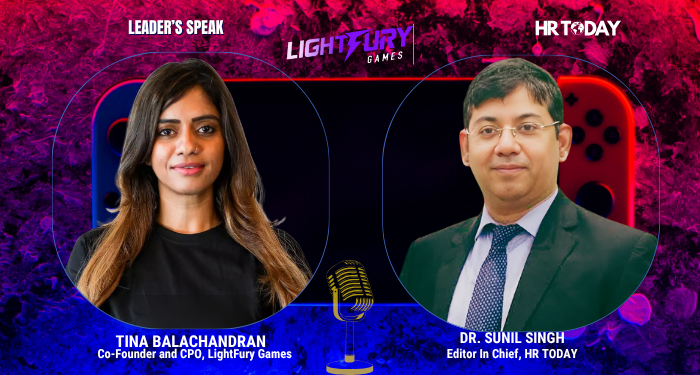
In an industry long dominated by offshore outsourcing and male-driven narratives, a quiet revolution is taking shape in India’s gaming ecosystem. Tina Balachandran, Co-Founder and Chief People & Operations Officer at LightFury Games, is at the forefront of this change — building one of India’s first AAA gaming studios from the ground up. In this deeply insightful conversation with Dr. Sunil Singh, Editor-in-Chief of HR TODAY, Tina shares how shifting visa landscapes, returnee talent, and the rise of women leaders are transforming India from a service hub into a creative powerhouse. From creating inclusive pipelines for women in tech to crafting culturally resonant global IPs, Tina offers a rare inside view into what it takes to build both products and people that redefine India’s creative identity.
Let’s dive in this exciting interaction:

Q1. You’ve co‑founded LightFury Games at a time when India’s gaming industry is gaining global attention. What inspired you to take this entrepreneurial leap, especially into AAA game development?
For us, LightFury was never just about starting a studio, it was about answering a bigger question: why should the world’s best games only be built elsewhere when India has the talent, the audience, and the hunger to create them right here?
India is home to more than 400 million gamers, yet most studios have been content being service providers, never truly building original IP that can stand on the world stage. Over the years, I kept seeing brilliant Indian engineers and artists leave the country to work on global franchises. Every time, it felt like an opportunity lost, talent born here but celebrated elsewhere. That gap became our spark.
LightFury is our answer: a studio built for India, from India, to the world. We wanted to show that Indian creativity and engineering can craft experiences as ambitious, polished, and emotionally resonant as any AAA studio abroad. Our debut title, E-Cricket, is more than just a game — it’s a statement. Entirely built in Bengaluru, it’s India’s first AAA cricket experience, and when Amazon invited us to showcase it at the Game Developers Conference 2025, it was a powerful signal: the world is ready to take Indian-made games seriously.
At the heart of it, LightFury exists because we believe this is India’s moment. Our story is about reclaiming ambition — proving that we don’t just play global hits, we create them. And in doing so, we hope to inspire the next generation of Indian developers, artists, and dreamers to stay, build, and make the world play our stories.
Q2. U.S. visa hurdles and global hiring slowdowns are reshaping career decisions for Indian tech talent. How do you see these shifts influencing women in creative tech roles specifically?
For a long time, the traditional career arc for Indian talent meant going overseas, studying abroad, working in the U.S., and building a career there. But that path is no longer predictable. Visa bottlenecks, immigration uncertainty, and global hiring slowdowns are forcing many to reconsider. What once felt like the only option is now just one among many.
This shift coincides with India’s own rise. With one of the youngest populations in the world, an average age of 28, and an economy on track to reach $5 trillion, growing at over 6% annually, India is emerging as a global power centre for creative industries. The scale of our engineering, design, and storytelling talent only reinforces this trajectory.
In gaming especially, the opportunity is immense. Instead of chasing roles abroad, talent can now build world-class experiences from within India. The canvas is wide open, from sports and mythology to RPGs and entirely new worlds, and India has both the talent and the audience to create games that resonate globally.
At LightFury, our own journey reflects this shift. The fact that we’ve attracted returnee talent and are building AAA-quality titles entirely in Bengaluru shows this is no longer just an aspiration, it’s real. The slowdown abroad, combined with India’s economic momentum, makes a compelling case: studios built here will not only create global IP but also generate thousands of local jobs and opportunities.
Every country designs strategies for its own growth. Right now, the macro and micro conditions are aligning in India’s favour. If we seize this moment, the potential isn’t just significant , it’s exponential.
“The slowdown abroad, combined with India’s economic momentum, makes a compelling case: studios built here will not only create global IP but also generate thousands of local jobs and opportunities.” — Tina Balachandran
Q3. Many women in tech face additional barriers like career breaks, mobility risks, and workplace bias. How is LightFury creating opportunities that address these challenges head‑on?
At LightFury, our philosophy is simple: talent and skill come first. The opportunity to build something world-class should be open to anyone with the drive and ability to make an impact. Equal, merit-based opportunities are at the core of how we hire and grow our team — it’s not about where you’ve been, but what you can create here.
We also recognise that careers are not always linear. Many professionals, particularly women, take breaks for family, health, or personal reasons. We actively welcome returnees because we value impact and creativity over conventional markers of productivity.
On the support side, we understand that life and work often intersect. When personal or medical needs arise, we respond with flexibility and empathy, tailoring solutions case by case. Our aim is to create a culture where people can do the best work of their lives without being constrained by rigid structures or outdated expectations.
Ultimately, LightFury is about giving ambitious talent the platform they deserve. For those who want to shape India’s first wave of AAA games, we provide not just opportunity, but the trust and support to succeed on their own terms.
Q4. You’ve spoken about “returnee talent” leaving global studios like Ubisoft, EA, and Rocksteady to join LightFury. What draws this talent back to India, and how does ownership play into that decision?
There’s a growing desire among Indian developers to move beyond executing for others and instead create original worlds and IP that reflect our own voice.
That’s why we’ve seen veterans from Ubisoft, EA, and Rocksteady return. Justin Farren, our Chief Creative Officer and a former Assassin’s Creed director, joined because he wanted to “transform the world’s perception of Indian game developers.” Our Art Director, Khan Mohamed Hussain, was drawn by the clarity of our vision and the leadership ensemble we’ve assembled — a team that signals India is serious about AAA. Across engineering, art, design, and animation, we’re attracting returnees who see LightFury as a chance to make history, not just production pipelines.
Ownership is central to this decision. At LightFury, talent doesn’t simply join a company — they co-own the narrative. With equity in the studio, they are shaping India’s first AAA franchise not just as employees, but as creators with real stakes in the outcome. Add to that the emotional pull of building from home, being closer to family, and contributing to national pride, and it becomes a powerful magnet.
Our debut IP, E-Cricket, is the perfect symbol of this mission: who wouldn’t want to help build the world’s best cricket game — right here in India, for a global audience? It’s a project that embodies both passion and purpose.
Q5. How different is the value proposition of working on a AAA title in India compared to offshore or outsourced gaming roles of the past?
Historically, Indian studios contributed to global projects by providing art, QA or support functions; creative decisions were made elsewhere. Most Indian studios remain in service roles for international players rather than developing original IPs. LightFury is working on flipping that model. Our teams design core gameplay mechanics, build physics systems, innovate AI pipelines and own features end‑to‑end. We’re assembling what we hope will be India’s first home-grown AAA cricket game, utilising AI-driven motion capture to drastically reduce production time. That means engineers here are leading inventions, whether it’s compressing animation pipelines or localising commentary with generative AI models. This shift from task execution to IP creation gives Indian talent deeper creative satisfaction and global visibility.
Q6. Gaming has long been a male‑dominated industry. What cultural and structural shifts are needed to make AAA game development in India more inclusive for women?
The gender gap is stark. Women make up only 12–14 % of India’s gaming workforce and just 6–9 % in tech roles. Leadership representation is even lower, with only 12–14 % of leadership positions in Indian gaming companies held by women. Addressing this requires both cultural and structural shifts:
- Cultural normalisation: We need to normalise women leading engineering and creative teams. That includes visible role models, storytelling that celebrates female leaders, and zero tolerance for sexist banter or gatekeeping.
- Intentional hiring and promotion: The report recommends inclusive hiring practices and combating bias in promotions. Companies must set targets, audit promotion cycles and ensure women are considered for stretch roles.
- Mentorship and sponsorship: Mentorship programmes can counteract limited networking opportunities. Senior leaders—male and female—should champion promising women, not just coach them.
- Flexible and safe work environments: Many women drop out due to mobility risks or lack of childcare. Remote/hybrid roles, secure transport options and childcare support make the industry more accessible.
- Policy advocacy: Industry associations should work with the government to fund scholarships, STEM programmes and incubators aimed at women.
If these structural supports are in place, cultural change will follow more naturally.
Q7. What role do mentorship and upskilling programs play in helping new graduates, especially women, enter high‑quality global gaming pipelines?
Mentorship and upskilling are vital bridges between academia and industry; lack of mentorship is a key barrier. At LightFury, we treat mentorship as part of the production pipeline. AI automates repetitive animation work, freeing senior engineers to coach fresh graduates in Unreal Engine and proprietary tools. Veterans who have shipped titles like Assassin’s Creed pair with juniors, offering both technical guidance and career advice. For women, throwing at them problems through mentorship offers their character building and shaping as future leaders, combined with formal on-the-job skilling and upskilling programmes, it demystifies the path into AAA roles and builds a supportive peer network.
Q8. As a woman leader in gaming, what personal experiences have shaped your vision for building both products and people at LightFury?
What moves me most is the idea of building things that last – products that don’t just entertain for a moment, but touch lives, scale globally, and create ripple effects far beyond the studio. At every stage of my career, whether it was scaling tech platforms or building new systems from scratch, I’ve seen how patience, nurturing, and the ability to adapt quickly are what truly set enduring products apart. That belief is now woven into LightFury’s DNA.
But building products is only half the story. What excites me equally is building people — creating an ecosystem where talent can take entrepreneurial paths of their own, where one studio’s success creates opportunities for dozens more. If we do this right, we’re not just making games, we’re creating an industry that could change millions of lives in India.
The pace of technological advancement keeps us on our toes – from AI pipelines to real-time physics, the bar keeps moving higher. To thrive, you have to be ahead of the curve, build for scale, and think collectively. Because when we innovate together, when we create opportunities at scale, the impact is larger than any one company, it’s the country that thrives.
At LightFury, that’s the vision: not just to ship a great AAA game, but to build a platform where both products and people grow in ways that leave a lasting mark.
“At LightFury, the goal isn’t just to ship a great AAA game — it’s to build a platform where both products and people grow in ways that leave a lasting mark.” — Tina Balachandran
Q9. Beyond gender, inclusivity in gaming also touches representation, storytelling, and workplace culture. How does LightFury integrate inclusivity into its games and its teams?
Inclusivity starts with recognising that India’s gaming audience is diverse. Research on Indian gaming markets notes that players resonate with culturally familiar stories and characters and that localisation beyond language is essential. In E‑Cricket, we reflect this by offering regional commentary, player celebrations, and avatars that mirror the diversity of Indian cricket fandom. On the team side, we strive for a flat creative culture. Ideas can come from engineers, designers or QA testers, and we try to avoid a hierarchy that privileges certain voices. We also foster cross‑disciplinary squads, artists work closely with AI engineers, and designers collaborate with tech artists and engineers. This not only improves the product but also allows people with different identities and expertise to learn from each other. Regular show and tell workshops and feedback loops help us detect and address bias in both our games and our behaviours.
Q10. India is often seen as a consumer market for gaming rather than a creator of global titles. How do you see LightFury and women leaders changing that narrative?
India’s status as a gaming consumption powerhouse is undeniable, with over half a billion gamers, but the country hasn’t yet produced global hit IPs. LightFury wants to prove that Indian studios can create, not just consume. We’re building a AAA cricket franchise that leverages AI, original IP and culturally resonant storytelling. Women leaders amplify that shift in two ways. First, they challenge the stereotype that game development is a male domain. Second, research shows diverse leadership yields more innovative products. By placing women in critical only breaking gender norms but demonstrating that inclusive teams produce better games. When E‑Cricket launches globally, we hope it will stand as a proof point that India can export AAA titles built by diverse teams and compete in the global marketplace.
Q11. What advice would you give to women in tech who are reconsidering their global career aspirations in light of visa uncertainties and exploring new sectors like gaming?
Gaming is one of the few sectors where technology, art and storytelling converge, and where you can work on globally relevant products without leaving India. Invest in building strong technical foundations, engines like Unreal or Unity, AI tools, scripting languages and seek out mentors. Look for studios that prioritise compelling products and long-term thinking and vision and remember that the skills you gain in gaming, systems thinking, user empathy, and rapid prototyping translate across industries. Don’t hesitate to pivot into gaming; the sector needs more voices like yours.
Q12. Looking ahead, do you believe India could witness a women‑led AAA revolution—and what would it take to make that vision a reality?
I believe a women‑led revolution is possible, across spectrums, but it will require intention and investment. The industry should also cultivate a pipeline by inclusion of STEM and game design in early schooling / academia. Investors and publishers need to back good promising studios which have true business and impact value. If we align these efforts with India’s growing market and the success of home‑grown IPs, it’s entirely plausible that the next big AAA franchise from India could be spearheaded by women, next-gen leaders and experts.
Achieving that would be the most powerful narrative shift of all.
About Tina Balachandran
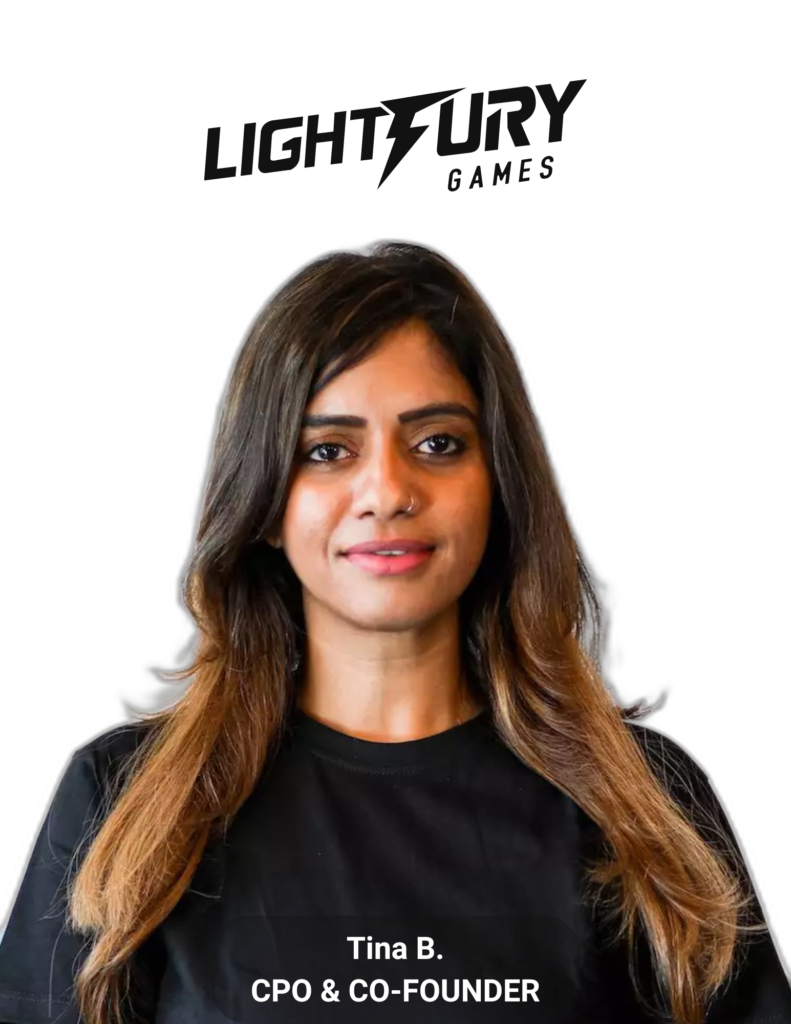
Tina Balachandran is the Co-Founder and Chief People & Operations Officer at LightFury Games, where she is spearheading one of India’s first AAA gaming ventures built entirely in-house. With over 18 years of experience in the consumer tech and gaming ecosystem, Tina has been instrumental in shaping high-growth organizations, driving transformation, and building sustainable people and product cultures. At LightFury, she is redefining how gaming talent, technology, and storytelling converge to create globally relevant IPs — empowering both returnee professionals and emerging women technologists to shape the future of interactive entertainment from India.
Before co-founding LightFury, Tina held leadership roles at Tencent Games and Unacademy, where she played a pivotal role in scaling operations and expanding strategic portfolios across APAC. A champion of design thinking and diversity-led innovation, Tina is deeply committed to building high-performance, inclusive cultures that combine creative freedom with ownership. Her vision for LightFury extends beyond gaming — to position India as a global powerhouse for innovation, inclusion, and home-grown creative excellence.
Read Also : From Policy to Purpose – Amit Prasad’s Blueprint for Inclusive HR at Hettich
Ishita Agghi, Co-Founder of CLIKD, on Building Career Discovery Tools for the Next Generation
Leading with Purpose: HR Transformation and Nation-Building with Dr. Vinay Ranjan, Director (HR), Coal India Limited
Empowering People, Driving Innovation: Shikha Rai on Canon India’s Future-Ready HR Transformation
Ruchi Mago, Head – Human Resources and Employee Experience at Orange Business – India explains “Embracing the Quotients of the Future”
Ashutosh Sinha, Managing Partner & Chief People Officer at Seintiv Talent Solutions, Decodes Gen Z and the Future of Work
Click Here to Join HR TODAY WhatsApp Channel