

Careers are too often framed as binary choices: land the perfect role now or wait indefinitely. That’s a costly illusion. In reality, careers are repeated games—sequences of moves where a smart next‑best choice can compound into superior outcomes over time. The point isn’t to compromise; it’s to strategically sequence your way toward greater leverage, optionality, and impact.
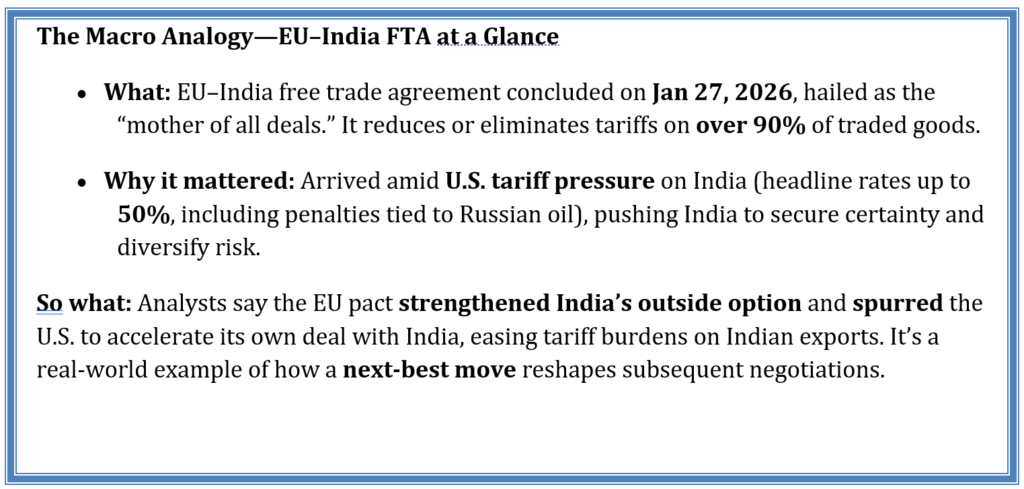
A timely macro analogy makes this clear. In January 2026, India concluded a landmark free trade agreement with the European Union—the “mother of all deals”—amid tariff volatility with the United States. The EU pact covered more than 90% of traded goods, with India securing preferential access across 97% of tariff lines; analysts add that this move strengthened India’s negotiating position and nudged Washington to accelerate its own deal with New Delhi. In other words, a well‑timed next‑best move reset the board.
Great careers aren’t built by waiting for perfection; they’re built by sequencing the right next move and letting momentum compound.
THE CAREER GAME: REPEATED, NOT ONE‑SHOT
In a one‑shot game, waiting for the optimal outcome may seem rational. But careers unfold across years and cycles. In repeated games, the winning strategy is to make credible, compounding moves that improve your future negotiating position.
- Movement beats stagnation. Taking a strong adjacent role generates visible outcomes, broadens your network, and signals resilience. Waiting does the opposite.
- Signals matter. Each shipped project, cross‑functional stint, or transformation you enable is a market‑tested signal that lowers a hiring manager’s risk perception.
The India–EU sequence demonstrates the same logic at geopolitical scale: lock in certainty with one large partner to improve your BATNA (Best Alternative to a Negotiated Agreement), then re‑enter talks with a tougher counterparty from a position of strength. The EU deal’s breadth and timing—amid U.S. tariff pressure—was a textbook case of improving outside options to alter subsequent payoffs.
Optionality is a career asset. Every adjacent skill you add increases your future bargaining power.
A Practical Playbook for the “Next‑Best” Move
1) Anchor on a Target Skill Stack (not a job title).
Define 3–5 capabilities you want to be known for in 24 months—say, workforce analytics, rewards design, or org effectiveness. Choose roles that shrink the delta to that stack by two or three steps. Think like a strategist: Will this move broaden my option value?
2) Optimize for optionality.
Prioritize platforms with internal mobility, cross‑functional exposure, and proximity to P&L decisions. Optionality compounds—each rotation increases leverage for compensation, scope, and project choice.
3) Signal cooperation and credibility.
Organizations reward professionals who keep the game moving. Deliver, document, and socialize outcomes. Trust is built in cycles; credibility is the currency that accelerates selection.
4) Use time‑boxed S‑curves.
Operate in 18–24‑month arcs: build, deliver, codify, transition, rotate. This cadence prevents premature plateauing and keeps compounding alive.
5) Negotiate an exit ramp upfront.
Before you accept a next‑best role, establish a 9–12 month review checkpoint tied to agreed outcomes. This creates an ethical, performance‑based path back to your original stream—or forward to a bigger one.
Why the “Next‑Best” Strategy Works
Sequential advantage. Like India sequencing the EU deal before the U.S., the order of moves matters. Establish capability and credibility in a strong adjacency; then pursue your ideal stream with higher bargaining power. Analysts observed that the EU pact’s conclusion was followed by an accelerated U.S.–India trade arrangement that reduced tariff overhang on Indian exports—timing that underscores how one strategic agreement can force better terms in the next.
Risk management. The EU–India pact was also a hedge against volatility in global trade—creating a predictable pathway amid shifting U.S. policy. Careers need similar hedges: when the “perfect” door doesn’t open, take the one that keeps capability compounding and reduces macro risk (market slowdowns, policy changes, budget freezes).
Signaling stability. The EU sought diversification; India sought durable access. The result was a trust‑based equilibrium—lower tariffs, clearer rules, and a shared commitment to predictable trade. Likewise, professionals who consistently deliver under constraints become magnets for sponsors and high‑impact opportunities.
“In careers—as in trade—sequence and signaling separate those who stall from those who scale.”
A Simple Payoff Matrix (and the Dominant Move)
- You get the exact role + you act: Maximum payoff.
- You miss the exact role + you act (next‑best move): High, compounding payoff.
- You get the exact role + you wait (or stagnate): Mediocre; momentum lost.
- You miss the exact role + you wait: Worst outcome.
In realistic markets, acting on a well‑chosen adjacency dominates waiting. It strengthens your narrative and pulls future opportunities toward you.
What HR Leaders Can Do Now
- Normalize adjacency. Write job descriptions for near skills, not just direct matches; publish clear 30/60/90‑day ramp plans.
- Fund the ramp. Invest in micro‑learning, shadowing, and coaching for internal movers; treat it as capability CapEx.
- Score mobility. Make managers’ support for internal movers a KPI; celebrate lateral wins publicly.
- Show the lattice. Map and communicate pathways from adjacencies to destination roles; make the lattice more visible than the ladder.
When a nation leverages a next‑best agreement to improve its position with a tougher counterparty, we call it statecraft. When a professional chooses a well‑designed adjacent role to unlock superior outcomes later, we should call it career craft. The next‑best move isn’t a consolation prize—it’s a high‑agency strategy for a world that rewards momentum, credibility, and optionality.
Read Also : The Great Rewiring: What India’s new labour codes really mean for employers
India’s Airline Crisis: When Efficiency Overrides Resilience
Rethinking Talent in the Age of AI: Why Workforce Agility Starts with the 4Bs
The Role of HR in Addressing Organizational Anxiety
Click Here to Join HR TODAY WhatsApp Channel
Author’s Note
This article has been developed and refined with the assistance of AI‑based editorial support tools. All ideas, arguments, and final editorial decisions originate with the author, while AI was used to enhance clarity, structure, and narrative flow in line with contemporary HR publishing standards.