


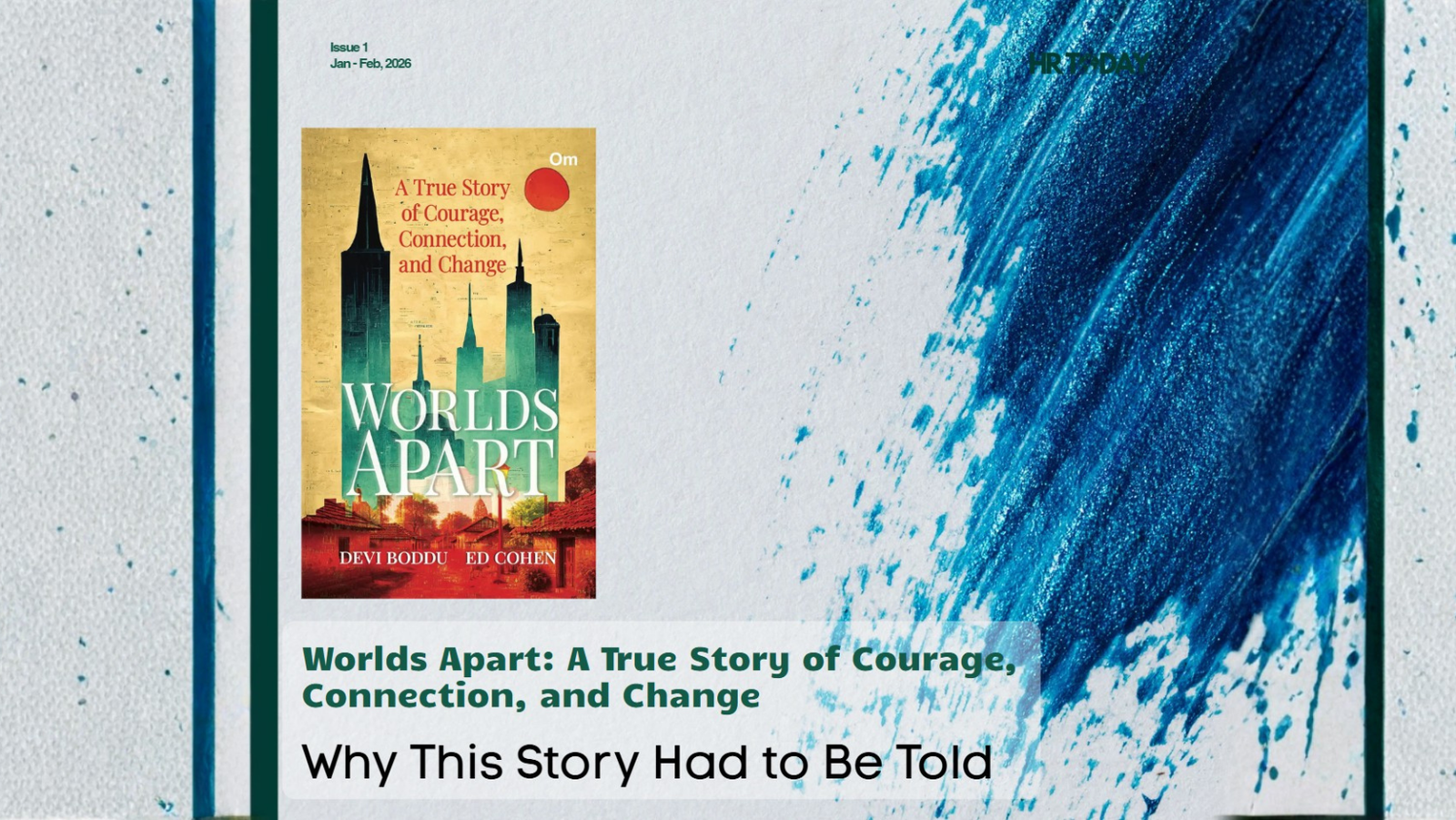
Worlds Apart: A True Story of Courage, Connection, and Change exists for a simple reason: education remains one of the most reliable ways to interrupt generational poverty, yet for millions of girls, it does not hold long enough to matter.
This is not a theoretical problem. It plays out quietly, every day, in homes where school is something to be negotiated rather than assumed, and in lives where the future narrows not because of lack of talent, but because access runs out.
At the center of this story is a girl who wanted to stay in school.
Growing up with limited resources, education was never guaranteed for Devi Boddu. It required persistence, improvisation, and constant vigilance. Around her, girls left school early—not because they lacked intelligence or ambition, but because circumstances steadily closed in. Financial pressure, social expectation, and early marriage reshaped what felt possible. Education, when it held at all, did so without certainty.
This book exists because that fragility is not unique to one family or one community. It reflects a broader human pattern—one that shapes lives, workforces, and societies. Worlds Apart tells a true story not to celebrate an outcome, but to examine what happens when education is allowed to endure, and what that endurance makes possible across generations.

A Girl Who Wanted to Stay in School
For Devi, education was never abstract. It was personal, fragile, and visible in its absence.
She grew up watching girls around her leave school early. Some were pulled out to support their families. Others were married young. Over time, their options narrowed, quietly and permanently. These were not dramatic departures. They were ordinary decisions shaped by necessity—decisions that carried lifelong consequences.
That reality was present inside Devi’s own family as well. She saw how limited education constrained opportunity for women across generations, including those closest to her. School was not assumed as a given stage of life. It was something that could disappear at any moment.
Completing school required endurance more than confidence. There was no guarantee that effort would be rewarded or that education would lead somewhere concrete. The path forward was unclear. What remained clear was the desire to continue.
This distinction matters. Devi did not pursue education with a defined outcome in mind. She pursued it because staying in school itself represented possibility—however undefined. That persistence, sustained over time, would prove more consequential than any single intervention.
When Education Does Not Hold
More than 300 million girls in India never complete school. Many leave early due to financial constraints, social expectations, or early marriage. These numbers are often framed as a dropout problem. In reality, they reflect a constraint problem.
For many families, the decision to interrupt a girl’s education is not driven by indifference or lack of aspiration. It is shaped by competing pressures—economic instability, household responsibility, safety concerns, and limited visibility into what education might realistically lead to. When resources are scarce, education can feel abstract compared to immediate needs. When examples of educated women thriving nearby are rare, the return on investment appears uncertain.
These constraints form a system that reinforces itself.
Girls who leave school early face fewer economic options. Limited income reduces household stability. Reduced stability makes it harder for the next generation to remain in school. Over time, the pattern becomes normalized—not because families stop hoping, but because alternatives feel out of reach.
Devi learned this not from data, but by watching. She saw how easily education could slip away, and how quietly its absence shaped the future. That awareness sharpened her determination to stay—not because success was promised, but because the cost of leaving was already visible.
A Parallel Truth — Education as My Way Forward
My understanding of education as a lever for change was shaped long before I met Devi.
I grew up in circumstances marked by instability and scarcity. Education offered structure when little else did. It created order where life felt unpredictable and became a pathway forward when few others were visible. Like Devi, I did not experience education as enrichment alone, but as survival—something that made movement possible.
Achievement became a way out. It also became a way to remain silent.
For many years, education and professional success allowed me to perform competence and capability without addressing what remained unspoken beneath the surface. Learning opened doors, but it did not resolve everything it carried me past. That distinction would matter later.
What connected Devi’s experience and mine was not similarity of circumstance, but a shared truth: when education holds, it creates possibility. When it does not, potential stalls—sometimes permanently. Education can change the trajectory of a life. It can also mask what has not yet been named.
That parallel would eventually shape how I understood leadership, growth, and the quiet power of continuity—lessons that sit at the heart of Worlds Apart.
Two People, Worlds Apart.
When my family moved to India, there was no plan for a story to emerge.
We arrived for work, adjustment, and the ordinary work of building a life in a new place. Like many families relocating across cultures, we were focused on stability—schools, routines, work, and learning how to navigate unfamiliar rhythms.
It was during this period that my daughter met Devi.
The meeting itself was unremarkable. There was no program, no intervention, no sense that anything consequential was beginning. Two young people noticed one another. Conversation followed. Over time, familiarity replaced distance.
What mattered was not the moment of connection, but what followed it. Education remained central. Study continued. Expectations did not shift. There was no promise of outcome, only continuity.
That distinction is essential. Nothing about the relationship altered Devi’s goals or redirected her path. It simply reinforced something already present: that education was worth protecting, even when it required effort to sustain.
For many stories of social mobility, the narrative suggests a turning point—a single act that changes everything. This was not that. What changed was far quieter. Education was allowed to hold.

Continuity Is the Difference That Compounds
Education rarely fails because of a lack of talent. More often, it fails because continuity breaks.
In Devi’s case, what made the difference was not intensity or intervention, but steadiness. School remained non-negotiable. Effort remained expected. Progress unfolded unevenly, as it does for most people, without drama or announcement.
This kind of continuity is easy to underestimate because it lacks spectacle. Yet over time, it suggests something powerful: that someone belongs in the work of learning, even when outcomes are uncertain.
Belief expressed this way does not inflate confidence. It normalizes effort.
Years passed. Exams were taken. Skills accumulated. Education did what it does best when it is allowed to persist—it created capability quietly, without requiring a narrative to justify it.
What matters here is not acceleration, but duration. Talent needs time. Confidence needs repetition. Education needs space to mature.
This is true inside organizations as well. Development rarely fails because people are incapable. It fails when support is episodic rather than sustained—when belief is conditional rather than durable.
Devi’s experience underscores a simple truth: continuity is not passive. It is an active choice made repeatedly over time.
When Education Holds Long Enough to Matter
Years later, the outcome of that continuity became visible—not as an exception, but as evidence.
Devi entered a profession that demands precision, persistence, and ongoing learning. Today, she works as a Microsoft Azure engineer in Hyderabad. The title itself is less important than what it represents: the maturation of capability over time.
This was not a leap. It was an accumulation.
Education did not separate Devi from her family or her context. It strengthened her ability to contribute to it. Responsibility did not disappear as opportunity expanded. It deepened.
That distinction is critical. Education, at its best, does not extract people from their communities. It equips them to change those communities from within.
Too often, success stories are framed as escape narratives. This one is not. It is a continuity narrative—one in which education holds long enough to transform possibility without severing connection.
For leaders, this offers a useful reframing. The question is not how to create exceptional outcomes, but how to design environments where capability has time to surface.
The Multiplier Effect Inside a Family
The most enduring impact of education rarely appears at the moment of achievement. It appears later, in the expectations that quietly take root.
In Devi’s case, the shift is already visible. Education is no longer fragile or debated inside her family. It is assumed. Younger relatives are encouraged to remain in school.
Academic continuity is protected rather than negotiated.
Most significantly, Devi’s own daughter is being raised with education as a given—not a gamble, not a privilege, but a foundation.
This is how generational cycles change.
Not through singular acts of generosity, but through altered assumptions. When education becomes part of identity rather than aspiration, it carries forward with quiet force. Children grow up expecting to learn. Families organize around continuity rather than contingency.
This multiplier effect is what makes education uniquely powerful as a lever for systemic change. One life does not change in isolation. Futures shift in clusters.
For leaders accustomed to thinking in systems, this pattern should feel familiar. Sustainable change rarely arrives through dramatic intervention. It emerges when conditions are stable enough for growth to compound.
Devi’s story demonstrates that principle in human terms. Education held. Capability matured. Responsibility expanded. The cycle did not repeat.
That is not inspiration. It is evidence.
Section 8: Leadership Reframed Through Reciprocal Growth
Stories like this are often misread as acts of goodwill elevated into meaning. In reality, they point to a more demanding leadership truth—one that challenges how growth is commonly understood.
What became clear over time was that development did not flow in a single direction. Education created opportunity for Devi. Her steadiness, discipline, and refusal to dramatize progress created perspective for me. Growth moved both ways.
This is the essence of reciprocal mentoring. It does not require symmetry. It requires attentiveness. One person may gain access and capability. Another may gain insight, humility, and a more honest understanding of how leadership is actually experienced notes.
For leaders, this can be uncomfortable. It suggests that learning is not something delivered downward through programs and frameworks alone. It emerges through proximity—by staying engaged long enough to see how systems feel to those moving through them.
Over time, Devi’s approach to effort—consistent, unentitled, and patient—made visible how much leadership can become performative when outcomes are prioritized over connection. Her growth did not demand recognition. It simply accumulated.
That contrast reframed how I understood leadership effectiveness. Results still mattered. Standards still mattered. What shifted was the measure of success—less about control or acceleration, more about whether conditions allowed others to develop without being rushed to prove their worth.
This reframing sits at the heart of Worlds Apart. Leadership, at scale, is not about standing ahead. It is about creating environments where growth can occur without distortion.
Section 9: Walking Beside as a Scalable Leadership Practice
The posture that best describes what emerged from this experience is simple: walking beside, not ahead.
Walking beside does not mean lowering expectations or abandoning accountability. It means resisting the urge to direct outcomes before understanding what someone actually needs to continue. It means staying present when progress is uneven or invisible. It means offering support that preserves dignity rather than creating dependence.
This stance is deceptively difficult. It requires patience. It requires leaders to tolerate ambiguity. It requires confidence that capability will surface if conditions are stable enough.
Yet it is precisely this posture that scales.
Inside organizations, walking beside shows up in how managers develop early-career talent, how leaders sponsor without controlling, and how learning systems prioritize continuity over episodic intervention. It shows up in who receives second chances, who is allowed to progress without spectacle, and who is noticed when effort precedes outcome.
This is not a soft approach to leadership. It is a durable one. Walking beside strengthens accountability by grounding it in relationship. It creates psychological safety without diluting standards. It allows people to bring their full capacity forward rather than performing versions of competence shaped by fear.
For organizations navigating complexity, cultural difference, and rapid change, this posture is not optional. It is often the only way growth sustains.
Why This Story Traveled
When a short reflection about Devi was shared online years later, there was no expectation that it would travel.
It did.
Millions read it. Messages arrived from leaders, educators, and practitioners across geographies. The responses varied in detail, but they converged in meaning. Many recognized the pattern immediately—not as an extraordinary story, but as a familiar one.
What resonated was not the outcome. It was the ordinariness of the beginning.
There was no grand plan. No defined roles. No formal intervention. Just people paying attention and staying engaged long enough for something to take root. In a world saturated with leadership models and performance narratives, that simplicity felt honest.
The story reminded readers of something they already knew but rarely named: that meaningful change often begins quietly, without certainty, and outside formal structures. It begins with noticing. It grows through continuity. It endures because belief is sustained.
That recognition is why Worlds Apart exists. Not to offer a blueprint, but to surface a pattern—one that leaders encounter daily, whether they see it or not.
The question the story leaves behind is not whether such change is possible. It is whether leaders are willing to slow down enough to allow it to happen.
Why Worlds Apart Exists—and What It Is Trying to Change
Worlds Apart: A True Story of Courage, Connection, and Change exists because stories like Devi’s are not rare—they are simply unfinished.
Millions of girls possess the same curiosity, discipline, and capacity. What differs is whether education holds long enough for that capability to mature. The book was written to make that pattern visible, not as inspiration, but as evidence.
From the beginning, one decision was clear. All of my author royalties from Worlds Apart in India are being donated to Project Nanhi Kali, an organization dedicated to supporting the education of underprivileged girls.
This decision is not symbolic. It is structural.
Education is one of the few interventions whose impact compounds across generations. It alters household expectations, strengthens economic participation, and expands leadership pipelines over time. Supporting girls’ education addresses the problem at its root—not through short-term assistance, but through sustained access and continuity.
For leaders accustomed to thinking in systems, this logic is familiar. Sustainable change does not come from isolated acts of goodwill. It comes from reinforcing the conditions that allow capability to emerge and endure.
That is what this story argues for—not charity, but commitment. Not rescue, but continuity. Not exceptionalism, but replication.
What Holds—and What Leaders Can Choose
The most important question raised by this story is not whether education can change a life. That is already well established. The question is whether leaders—inside organizations and beyond them—are willing to create conditions where growth is allowed to take root without being rushed, extracted, or distorted.
Devi’s story demonstrates what happens when education holds. Capability matures. Responsibility expands. The cycle does not repeat.
My own experience reflects a parallel truth. Education created a path forward when circumstances were difficult. It also allowed silence to persist longer than it should have. Growth, it turns out, is not only about access. It is also about presence—about being seen, supported, and allowed to develop without performance becoming the only currency.
This is where leadership ultimately lives.
Not in frameworks alone, but in everyday choices. In who is noticed. In who is supported when progress is uneven. In whether belief is extended long enough to matter.
Worlds Apart does not offer a model to be copied. It surfaces a pattern to be recognized. One education holds. Then another. Then a family assumes what once felt uncertain. Over time, futures change.
That is how cycles break. Quietly. Consistently. And, when leaders choose it, permanently.
I am grateful to Dr. Sunil Singh, Chief Executive Officer of HR Today Magazine, for his leadership and for providing a platform to share this story with the HR community.
About The Book
Worlds Apart: A True Story of Courage, Connection, and Change is published by OM Books International and will be launched at the World HRD Congress 2026 in Mumbai.
When you purchase the book, all of the author’s royalties from India support Project Nanhi Kali, helping more girls stay in school and create futures of their own.
When you buy the book, you are not just reading a story.
You are helping write the next one.
Read More
In 2034, the world will be ruled by a self-aware AI … so should I still aim to be an accountant?
Shaping the Future of Work: The Impact of Digital and AI on Human Resource Transformation
Organizational Effectiveness An Evolution from Human Intelligence to Artificial Intelligence