


The global economy is evolving faster than ever, driven by digital disruption, AI innovation, and the redefinition of work itself. India is undergoing a workforce transformation at a scale and speed rarely seen before. As this disruption accelerates across sectors, from manufacturing and financial services to healthcare and retail, a critical question looms large for business leaders: Do we have the right skills to win the future? Often, the answer is no. In this new reality, it is not capital or infrastructure, but skills that have become the true currency of competitiveness.
The stark reality is that most companies are navigating this future with legacy workforce strategies. The World Economic Forum’s 2025 Future of Jobs Report reveals that 63% of global employers identify skills gaps as a top barrier to business transformation. In India, this challenge is even more pronounced. The India Skills Report 2025 shows that while national employability has risen to 54.8%, critical capability gaps persist across key areas like AI, cloud, cybersecurity, and data analytics.
This rapidly changing landscape demands a holistic, dynamic approach to talent planning, one that balances the need for speed with long-term capability building. A framework that is particularly relevant in this era: the 4B model: Build, Buy, Borrow, and Bot.
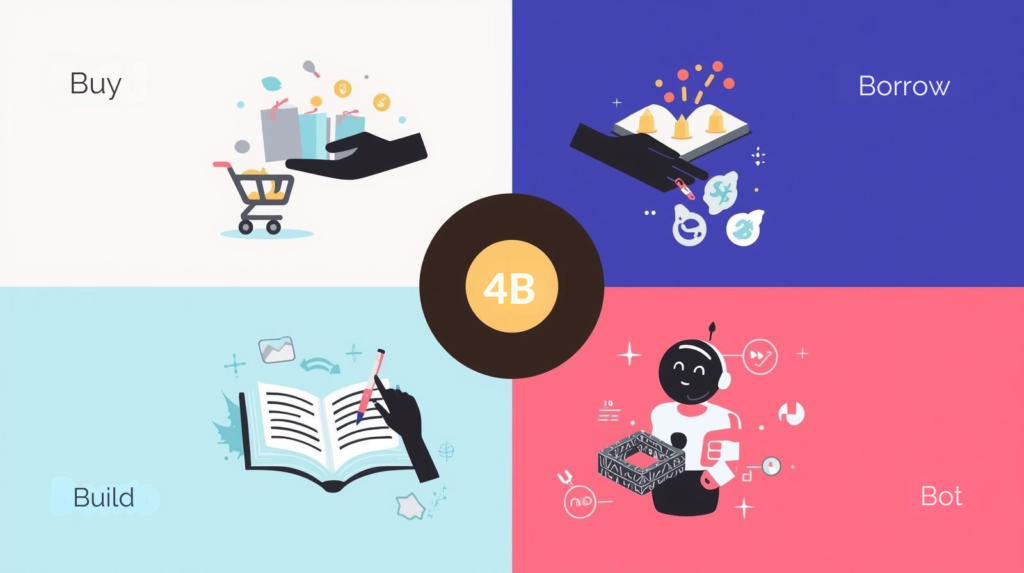
This framework provides a dynamic roadmap for organizations to respond to shifting talent needs, balancing internal development, external hiring, flexible talent deployment, and intelligent automation. It’s not a theoretical model, but a practical operating system for the skills economy. Let’s break it down.
1. Build: Developing from Within
“Build” refers to the upskilling and reskilling of internal talent, a strategy that is gaining renewed urgency as the half-life of skills drops below three years. In fast-moving domains such as GenAI, sustainability, and digital operations, even today’s high performers must be constantly reskilled to stay relevant.India’s demographic advantage of over 65% of the Indian workforce under 35, offers an immense potential and allows for a youthful and dynamic talent pool. It is uniquely aligned to meet the demands of industries across the Gulf Nations, Southeast Asia, Europe, and Africa. The 2025 India Skills Report highlights that this has led to a 60% increase in job searches from technology, healthcare, renewable energy, and AI.
To unlock this potential, organizations must:
- Map internal skill inventories using AI-powered workforce intelligence
- Build targeted learning pathways aligned with future business priorities
- Track development outcomes not just by course completion but by skill proficiency, internal mobility, and time-to-competence
Internal development also drives retention as employees who see a future with their organization are far more likely to stay and grow.
2. Buy: Hiring for Impact
There are times when speed triumphs patience, when the business need is immediate, highly specialized, or strategically critical. This is where “Buy” becomes essential.
A case in point is the AI talent shortage. As per a recent report, India has just one qualified GenAI engineer for every 10 open roles. At the same time, 64% of Indian companies have made GenAI a strategic priority, but 75% still lack change-readiness plans.
Hiring from the external market offers access to domain experts, cutting-edge thinkers, and capabilities that may take years to develop internally. But external hiring should be strategic, and insight driven.
Leaders must assess:
- Whether the talent required is available in the external market
- How to integrate and retain that talent post-hire
- Whether hiring will contribute to building long-term internal capability
In other words, hiring shouldn’t be a substitute for internal development but it should complement it.
3. Borrow: Agility through Flexibility
The pandemic normalized the gig economy, but today’s flexible talent models go far beyond freelancers. “Borrowing” in the 4B model means utilizing:
- Internal talent temporarily reassigned to high-priority projects
- External consultants or contractors to address short-term gaps
- Cross-functional talent pools that adapt based on changing priorities
According to Indeavor’s 2025 Workforce Trends Report, 84% of organizations now actively use contingent talent, and nearly 40% of the U.S. workforce operates in non-permanent roles, a trend India is rapidly catching up to, particularly in sectors like logistics, IT services, and creative industries.
Borrowing talent must be structured, not reactive. Organizations need:
- Internal talent marketplaces powered by AI to match people to gigs
- Strong onboarding and offboarding processes to ensure knowledge transfer
- A culture that encourages managers to share high-potential talent across teams
This agility allows businesses to respond to short-term opportunities without long-term commitment, especially valuable in times of market uncertainty.
4. Bot: Amplifying Human Potential with AI
The fourth lever “Bot” is perhaps the most transformative. It refers to the use of AI and automation to augment or, in some cases, replace human labor in routine, high-volume tasks.
The adoption of AI is already robust. According to U.S. survey conducted via Dynata, while AI has quickly become an integral part of modern work (80% of U.S. and U.K. workers respectively use AI) its usage is primarily happening in silence. Only 44% of U.S. employees have received AI training and tools, with just 16% receiving training often, and 51% of U.K. employees have never or rarely received training. Employees are looking to their organizations for more direction: 65% of U.S. workers want training to build AI skills and confidence, and 65% of U.K. workers want AI training. This presents a dual opportunity: scale automation while upskilling people to thrive alongside it.
A “Bot” strategy must be redesigning work, not just reducing cost. That means:
- Identifying repeatable tasks that can be automated
- Training employees to work in tandem with digital tools
- Measuring outcomes not just in efficiency, but in employee engagement, role evolution, and productivity gains
When bots take care of the mundane, humans can focus on what they do best such as creative thinking, complex decision-making, and customer empathy.

The Strategic Imperative: Integrating the 4Bs
These four levers: Build, Buy, Borrow, Bot are not independent silos. Their true power lies in integration.
A capability built internally today may be bought tomorrow to accelerate scale. A borrowed skill for a short-term project may reveal a need for automation. A bot strategy may free up capacity that can be redeployed into new growth areas.
The goal is to build a resilient, adaptable talent architecture, one that flexes as markets shift, technologies evolve, and business models transform. To do this effectively, organizations must invest in:
- Real-time labor market analytics
- Workforce intelligence platforms to track and forecast skill needs
- A leadership mindset that sees workforce strategy as core business strategy, not just an HR concern
India’s Opportunity Window
The next decade will determine whether India becomes a global talent powerhouse or grapples with structural skill stagnation. The government’s initiatives from the National Skill Development Mission to the launch of the India AI Mission and AI Safety Institute signal strong intent. But the private sector must lead the execution by adopting the 4B model, Indian enterprises can:
- Build critical skills that align with long-term growth
- Buy niche expertise to accelerate innovation
- Borrow with agility to stay lean and responsive
- Bot to unlock human potential and drive exponential outcomes
In the new world of work, agility is the new currency of success. Organizations that design their workforce around dynamic skills need no static job descriptions. They will be the ones that lead, adapt, and endure.
Read Also : Building High-Performance Offshore Teams in 90 Days: Best Practices to Align Culture, Compliance and Connection
People First: How Employee-Centric Strategies Fuel Organizational Success
The Role of Leadership in Building Organisations
Gender, Diversity, and Inclusive Leadership: Embedding Inclusion into the Organizational DNA Beyond Compliance