

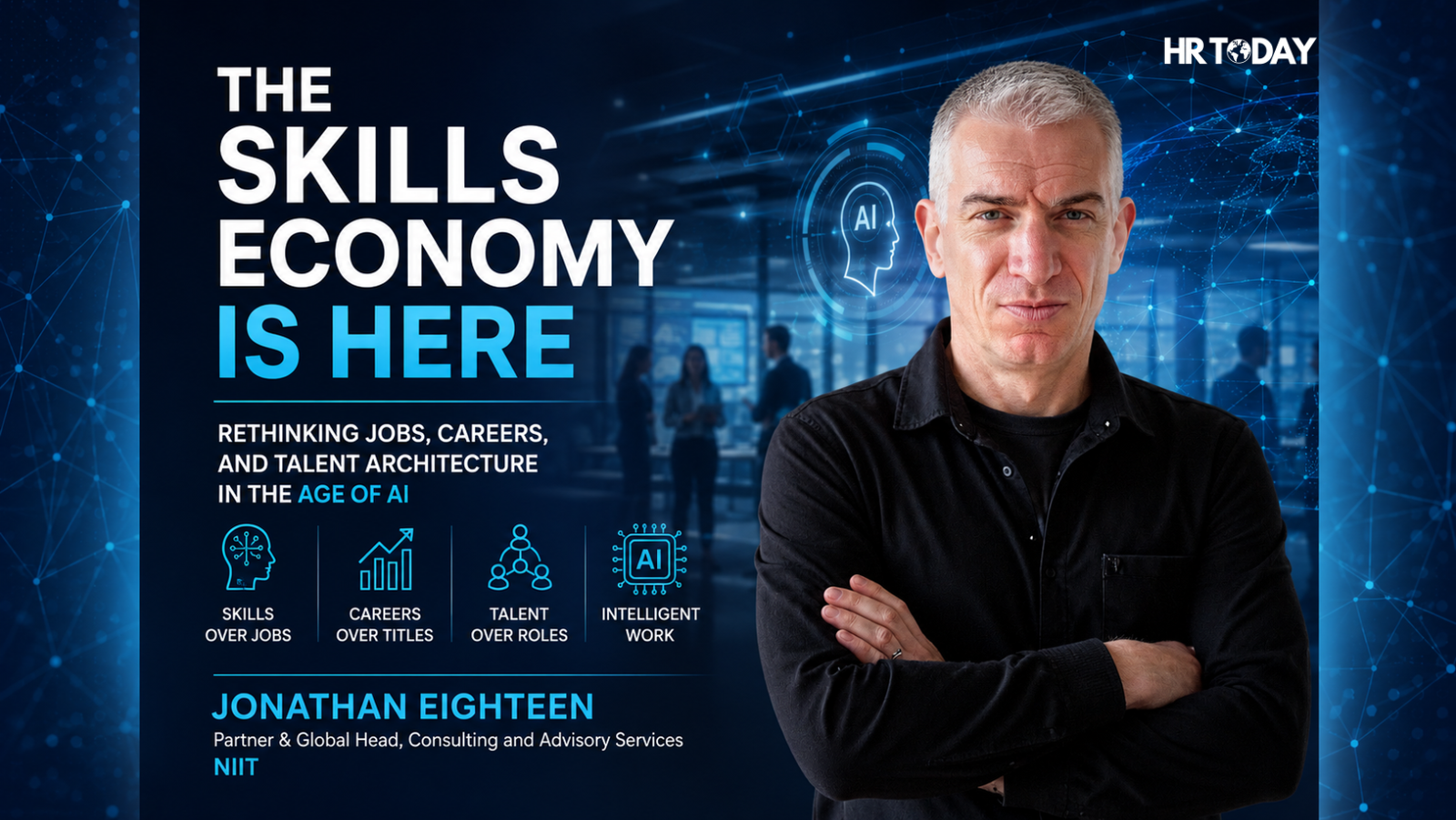
The phrase “skills economy” has been around long enough to lose most of its edge. The Skills-Based Organisation has become the dominant model on the table for serious HR functions. What changed in the past eighteen months is that the underlying premise of both — that the skill itself can be defined precisely, measured reliably and refreshed quickly enough to be the unit of account for the modern enterprise — has finally met something it cannot accommodate.
That something is artificial intelligence, but not in the way the headlines suggest. AI has not changed L&D. AI has changed what work is. We are now operating in what we call the era of Intelligent Work — work performed jointly by humans and the agents they build, train and govern. Once you accept that framing, almost every assumption baked into the existing talent architecture has to be examined again.
In recent conversations with CLOs, Heads of Talent and CHROs the same point keeps surfacing. Most already know the operating model they inherited will not stretch, and are waiting for a vocabulary to describe what comes next. Here is one.
Four numbers that should make a board uncomfortable
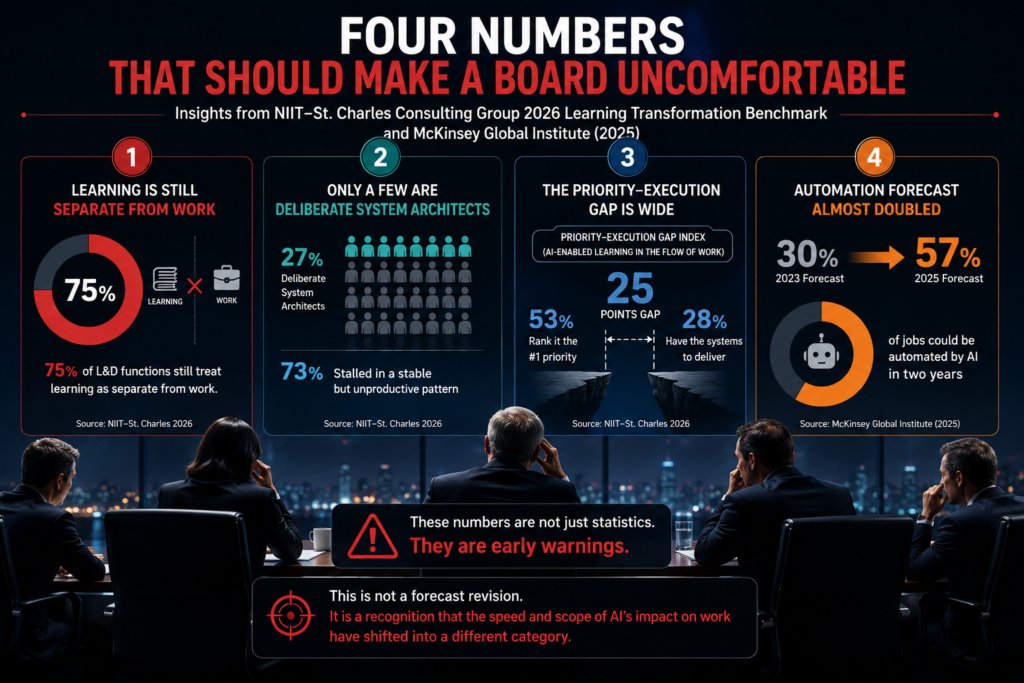
Three come from our 2026 Learning Transformation Benchmark (NIIT with St. Charles Consulting Group; senior L&D leaders across eight industries; set out in our Point of View, Learning Transformation 2.0: The Reinvention Imperative). The fourth is McKinsey’s.
Seventy-five per cent of L&D functions still treat learning as separate from work. Only twenty-seven per cent of organisations are what we call Deliberate System Architects — those that build the architecture before they accelerate. The remaining seventy-three per cent are stalled in a stable but unproductive pattern.
Our Priority-Execution Gap Index measures the distance between what an organisation says it wants to do and what it is actually equipped to do; the largest gap we have measured runs at twenty-five points, on AI-enabled learning in the flow of work, where fifty-three per cent rank it the number-one priority but only twenty-eight per cent have the systems to deliver it (all three NIIT/St. Charles 2026).
In two years McKinsey has almost doubled its forecast for automation, from thirty to fifty-seven per cent of jobs (McKinsey Global Institute, 2025). That is not a forecast revision. It is a recognition that the speed and scope of AI’s impact on work have shifted into a different category.
The global skills landscape
The structural pressure is universal but plays out differently. In advanced economies including the US and the EU, the challenge is reinvention at scale. The US faces acute mismatches in AI, data engineering and applied technology, with demand outpacing supply while significant portions of the workforce hold skills the market is actively repricing downward. EU economies face compounding pressures — ageing workforces, structural unemployment in legacy industries, and a fast-evolving regulatory environment. The EU AI Act alone will redefine compliance and governance requirements across every regulated sector.
In emerging economies, the picture is more nuanced than conventional framing suggests. The EY Global AI Sentiment Survey classifies India as a Pioneer Market for AI adoption, alongside China, the UAE and Saudi Arabia. In those markets, 94 per cent of people report using AI. India is not behind; it is moving fast. That is exactly where the risk concentrates: adoption is outrunning institutional readiness, and the skills being built at scale today risk being calibrated for a version of work that AI will substantially absorb within a decade.
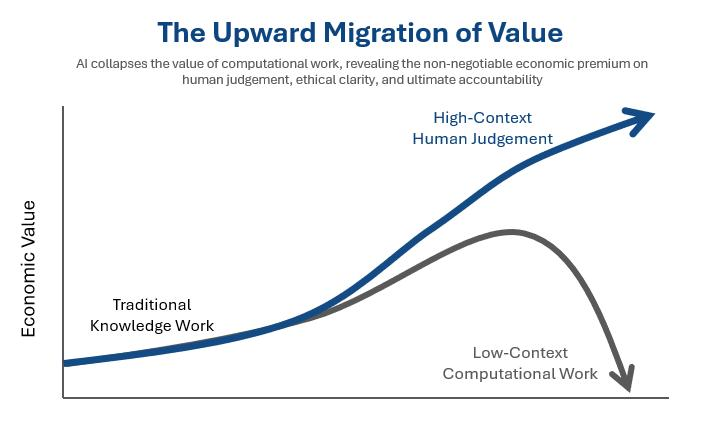
The Capability Inversion
Beneath those numbers sits the Capability Inversion. Seventy to eighty per cent of enterprise L&D spending currently targets declarative knowledge (the things people need to know — regulations, products, technical facts) and procedural tasks (the steps people need to perform — processes, workflows, defined routines). AI can absorb roughly ninety-five per cent of the first and eighty per cent of the second. The two categories AI is not automating — judgment and relational capability — absorb only about fifteen per cent of L&D investment between them. In an Intelligent Work environment that ratio needs to invert. The organisations most disciplined about formalising the old categories are the ones whose investment portfolios are now most exposed.

The Great Skills Repricing
We call what is happening the Great Skills Repricing. AI reprices skills the way a sudden change in exchange rates reprices a currency. Some lose value overnight; others that had no premium are suddenly worth a great deal. Four mechanics drive it:
Skill Velocity — the rate at which new skills emerge and become mainstream.
Skill Acceleration — the rate at which both emergence and obsolescence are themselves speeding up.
Skill Decay — how fast an existing skill becomes obsolete.
Skill Currency — what a skill is worth in the labour market right now. Tasks that signalled competence five years ago now signal almost nothing; judgment under uncertainty, AI output verification, applied systems thinking and agentic workflow design command salary premiums for which no settled hiring pipeline yet exists.
Three industries make the mechanic concrete. In pharma, AI is absorbing regulatory writing, MLR review and protocol drafting — the work that anchored a career path. In financial services, the procedural edifice of compliance and risk is being remade in real time, the premium shifting to judgment on edge cases. In professional services, the pyramid is under structural review by the Big Four themselves. Old skills are being repriced down; new ones, often unnamed, are being repriced up.
The Judgment Turn
The Microsoft 2026 Work Trend Index, published this month, makes the point empirically: eighty-six per cent of AI users say they treat AI output as a starting point and that they “stay responsible for the thinking.” That is the operative phrase. AI handles the procedural; judgment over the outcome stays human.
In our research the capabilities AI cannot easily replace cluster around the dual mandate of Capability and Judgment. Judgment here is not a soft skill. It is the disciplined practice of knowing when to trust the machine, when to override, escalate or govern — alongside the human capabilities now more valuable because they are not yet automated: curiosity, resilience, collaboration, critical thinking, social and emotional intelligence.
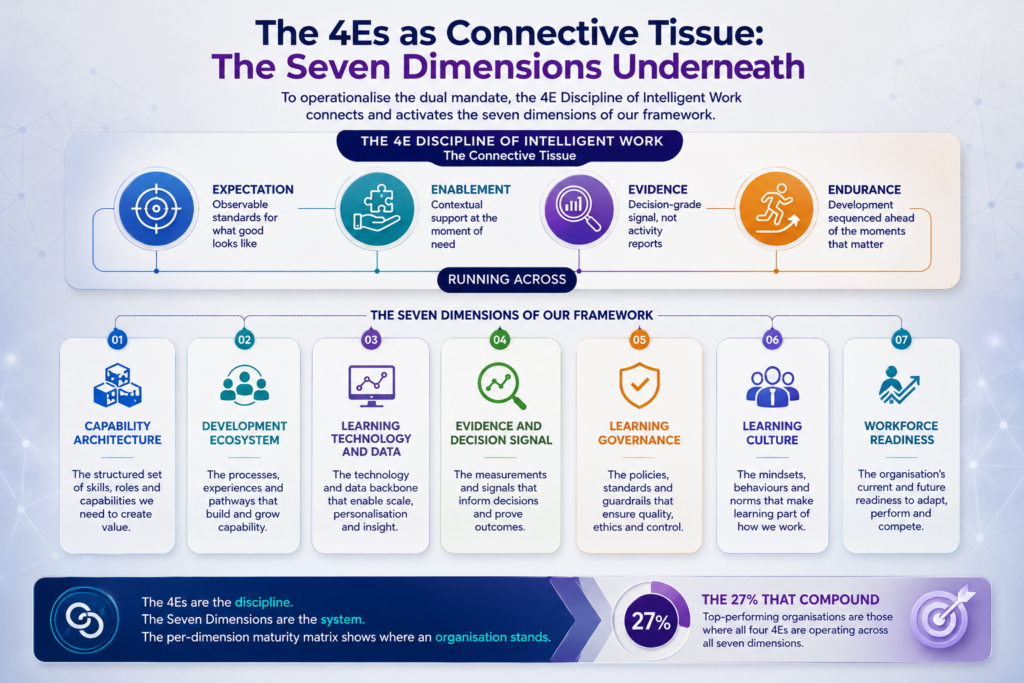
The 4Es as connective tissue: the Seven Dimensions underneath
To operationalise the dual mandate we apply the 4E Discipline of Intelligent Work: four conditions that must hold simultaneously — Expectation (observable standards for what good looks like), Enablement (contextual support at the moment of need), Evidence (decision-grade signal, not activity reports), and Endurance (development sequenced ahead of the moments that matter). The 4Es are the connective tissue.
They run across the Seven Dimensions of our framework: Capability Architecture, Development Ecosystem, Learning Technology and Data, Evidence and Decision Signal, Learning Governance, Learning Culture, and Workforce Readiness. The 4Es are the discipline; the Seven Dimensions are the system; the per-dimension maturity matrix is how an organisation diagnoses where it sits. The twenty-seven per cent that compound have all four conditions running mostly across all seven.
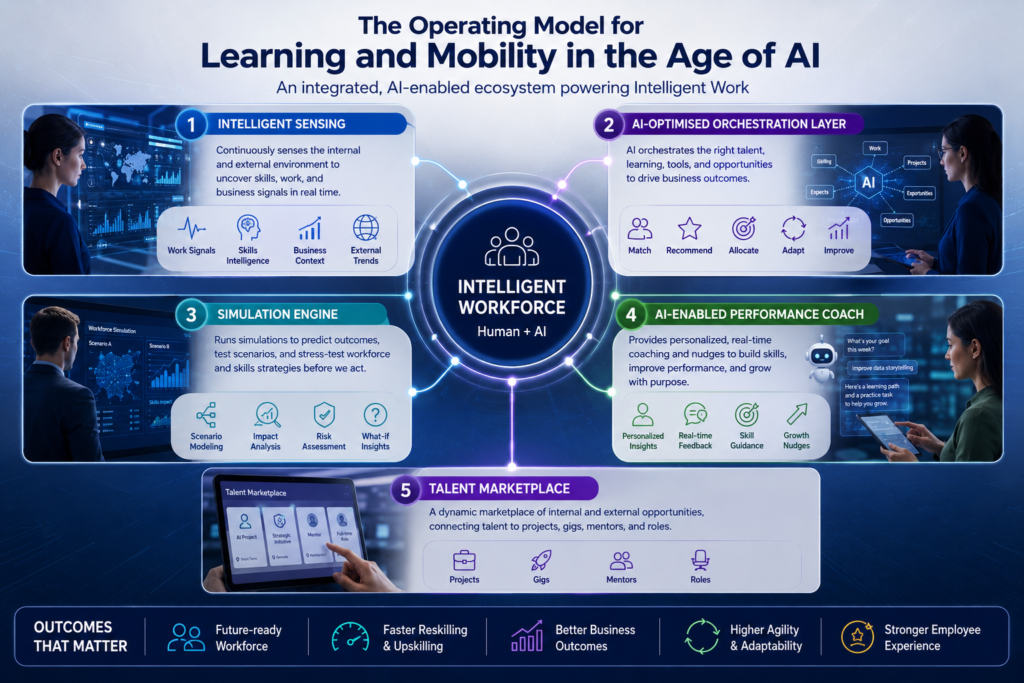
The operating model for Learning and Mobility
We envisage a new operating model that integrates Learning and internal Mobility as one system; the same skills data feeds both. There are five components:
Intelligent Sensing. Continuous reading of work signals that detects skill gaps before they are requested. Replaces periodic training-needs analysis. Engine of Endurance.
A human-led, AI-optimised orchestration layer. Strategy, design, governance and decision rights live here. Humans direct; agents execute under named guardrails. Where Expectation is held.
A Simulation Engine. Practice surface that spins up realistic scenarios on demand — conduct sims in regulated industries, conversation rehearsal in commercial roles, system practice in operations. Judgment rehearsed under safe conditions. Engine of Enablement.
An AI-enabled Performance Coach. The relationship layer with every employee. One coach reading performance, motivation and organisational support, delivering adaptive paths, in-flow nudges and readiness scoring. The completion dashboard is replaced by a capability ledger. Engine of Evidence.
A Talent Marketplace. The mobility layer. Internal opportunities matched on skill adjacency and currency trajectory, not job-title proximity. Connected directly to Intelligent Sensing for live demand and to the Performance Coach so development ties to real moves.
Together, the five components turn L&D and internal mobility from two separate functions into one infrastructure for Capability Orchestration and Judgment.
What I would say to an HR leader reading this
The skills economy is real, but the skill is being repriced. Velocity, acceleration, decay and currency are the four mechanics. Capability and Judgment have replaced knowledge and procedure as what L&D builds. The 4Es are the connective tissue; the Seven Dimensions are the system; the five operating-model components deliver it.
The choice in the next eighteen months is not whether you will have an AI-powered learning and mobility ecosystem — you will. The choice is whether it sits bolted on top of an inherited operating model nobody had the courage to rebuild, or becomes the infrastructure your business runs on, built before your competitors do.
In five years, half the senior people reading this will not have their current job title. All of them will have a bigger one — Capability Strategist, AI Orchestrator, Evidence Designer, Experience Architect. Those roles are being hired for in your companies, this week. The economy has already changed. It is the architecture’s turn.
Jonathan Eighteen leads Learning Transformation strategy for NIIT, working across Australia, EMEA, Europe and North America. The frameworks above — the 4E Discipline of Intelligent Work, the Seven Dimensions, the Capability Inversion, the Great Skills Repricing, the Priority-Execution Gap Index and the four archetypes — are set out in Learning Transformation 2.0: The Reinvention Imperative, proprietary IP of NIIT and its wholly owned subsidiary, St. Charles Consulting Group, 2026.
Read Also : When Technology, Business, and HR Converge: Why Embedding Ethical AI at Scale Matters
Burnout Isn’t a Time Management Problem—It’s a Leadership Problem
Learning, Education and Pedagogy in the age of AI : Developing Human Capital for the coming Decades
Rethinking Talent in the Age of AI: Why Workforce Agility Starts with the 4Bs
The Rise of the Chief Human Agency Officer: Why Every AI Organization Will Soon Need One