

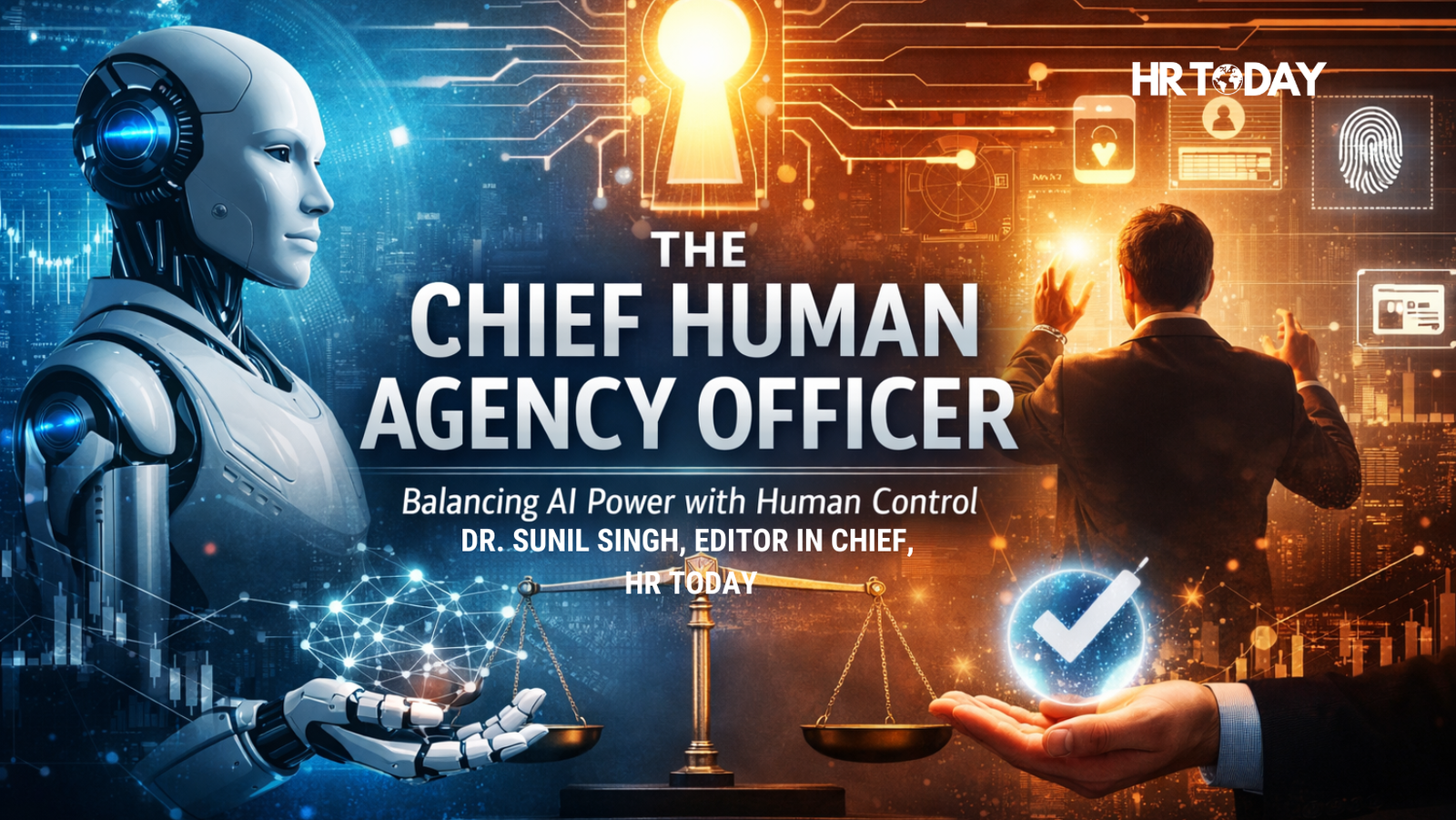
When Ian Rogers took on the role of Chief Human Agency Officer at Ledger, the title caught people off guard. It sounded futuristic, almost abstract. But if you look closely, it may well be one of the most practical and necessary roles emerging in modern organizations.
What’s really happening here is not about a new designation—it’s about a shift in how work gets done.
For years, artificial intelligence has quietly supported us. It helped draft emails, analyze data, recommend actions, and automate repetitive tasks. In that phase, AI behaved like an assistant—useful, efficient, but still clearly under human direction.
Now, that boundary is starting to move.
AI is no longer just suggesting what to do. It is beginning to act. It can rebalance portfolios, trigger transactions, manage workflows, and make operational decisions at a speed and scale no human team can match. This new form is often called “agentic AI”—systems that don’t just think, but execute.
At first glance, this seems like progress. And it is. But it also introduces a new layer of complexity that most organizations are not fully prepared for.
Because once AI starts acting, a simple but uncomfortable question emerges: who is actually in control?
Not from a technical standpoint, but from a human one. Who takes responsibility for a decision made by an algorithm? Who ensures that the decision aligns with the organization’s values? Who explains it when something goes wrong?
This is where the idea of “human agency” becomes critical.
In simple terms, human agency means that humans remain in control of meaningful decisions, even when machines are involved. It’s a principle we’ve always followed instinctively. Airplanes have autopilot, but pilots remain in charge. Financial systems have automation, but humans oversee critical approvals.
But as AI becomes more capable, this balance is no longer guaranteed. The risk is not that AI will fail—it’s that it will succeed so efficiently that we stop questioning it.
That’s a dangerous place for any organization to be.
Imagine a system that approves financial transactions faster than any human could review them. Or a hiring algorithm that filters candidates with perfect efficiency—but carries hidden bias. Or a supply chain system that optimizes costs but overlooks long-term risk. These are not hypothetical scenarios anymore; they are already beginning to appear.
The challenge, then, is not whether to use AI. It is how to use it responsibly without losing control.
This is exactly the gap the Chief Human Agency Officer is meant to fill.
Unlike traditional roles, this one doesn’t sit neatly within HR or technology. It sits in between. It is about ensuring that as AI becomes more powerful, it remains aligned with human judgment, organizational values, and ethical boundaries.
A Chief Human Agency Officer is not there to slow AI down. Quite the opposite—they enable organizations to use AI confidently by putting the right guardrails in place. They help define where automation is appropriate and where human oversight is essential. They ensure that decisions made by machines can be traced, understood, and, if needed, challenged.
At Ledger, this thinking is especially relevant. Operating in the world of digital assets, where decisions can be instantaneous and irreversible, the stakes are incredibly high. The organization’s approach reflects a simple but powerful idea: let AI bring speed, but ensure humans retain control.
This includes building systems where AI actions are traceable, where identities—human or machine—are verified, and where critical decisions still require human validation. It’s not about limiting AI; it’s about making sure it operates within a framework of trust.
And that is the real story here.
Because what Ledger is doing today, many organizations will have to do tomorrow.
As AI becomes embedded across industries—from banking and healthcare to retail and manufacturing—the same questions will arise everywhere. Where should AI decide? Where should humans intervene? How do we ensure accountability without sacrificing efficiency?
These are not technical questions anymore. They are leadership questions.
And like every major shift in business history, new roles will emerge to address them. There was a time when companies didn’t have Chief Information Officers. Then technology became central to business. The same happened with digital roles, and later with people leadership at scale.
Now, AI is driving the next evolution.
The Chief Human Agency Officer may soon become as essential as any of those roles—not because it sounds innovative, but because it solves a real and growing problem.
The future of work will not be defined by whether organizations use AI. That is already decided. It will be defined by how they balance intelligence with judgment, speed with control, and automation with accountability.
AI will bring incredible capability. But capability without control is risk.
The organizations that succeed will be the ones that understand this early—and design their leadership structures accordingly.
That’s why roles like the one taken up by Ian Rogers are not just interesting headlines. They are signals of what is coming next.
And perhaps, a reminder that in a world increasingly shaped by machines, keeping humans meaningfully in control is not optional—it is essential.
Read Also : The Great Rewiring: What India’s new labour codes really mean for employers
India’s Airline Crisis: When Efficiency Overrides Resilience
Rethinking Talent in the Age of AI: Why Workforce Agility Starts with the 4Bs