

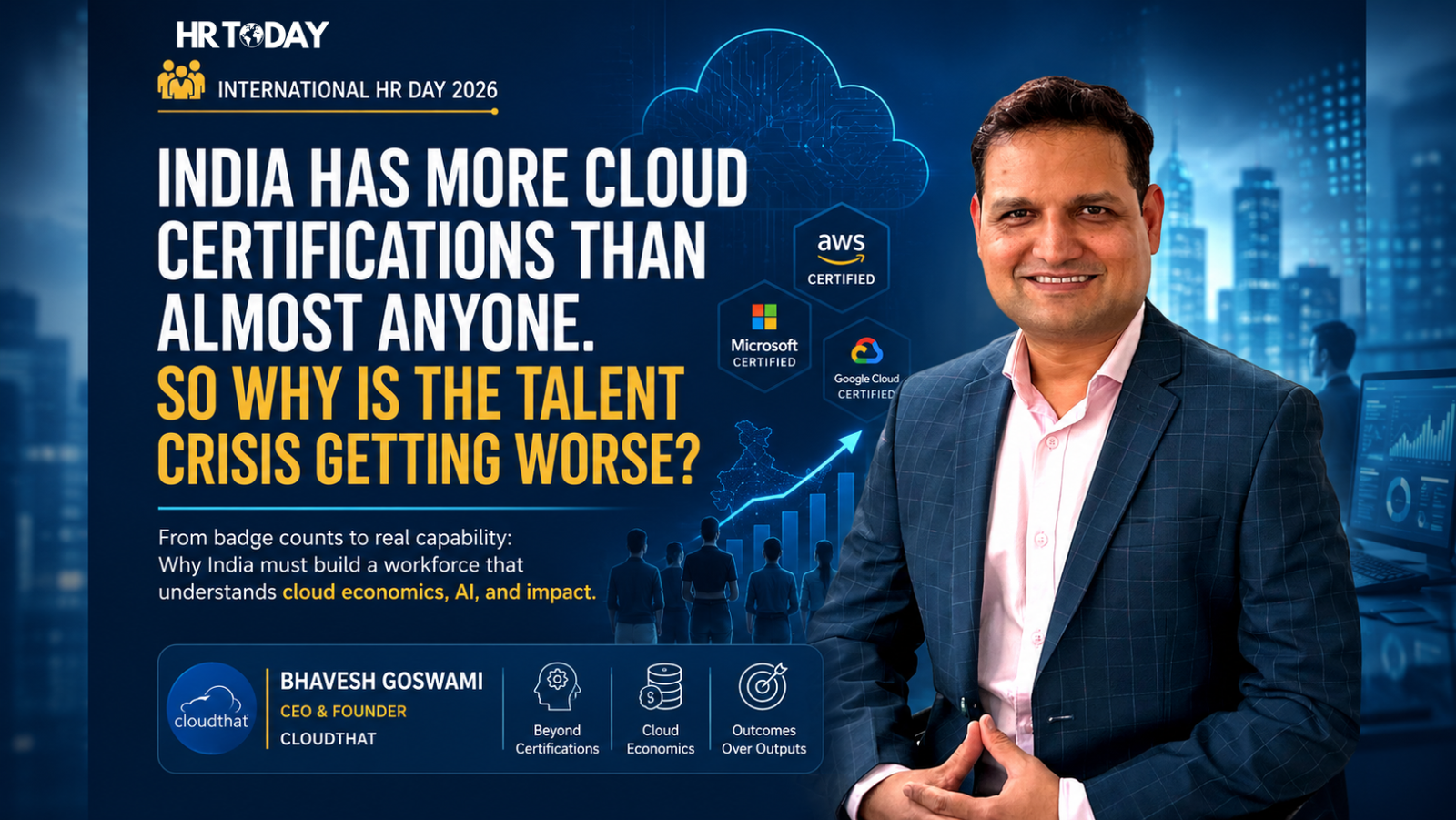
According to a joint NASSCOM-Deloitte report, India will need over 1.25 million AI and cloud professionals by 2027. Today, with an estimated talent base of roughly 420,000 (and only 16% of IT professionals AI-skilled) the country faces a shortfall approaching 50%. NASSCOM has said it plainly: India does not have a certification shortage. It has a talent shortage.
This matters because the numbers on paper look extraordinary. TCS trained 350,000 employees on AI in 2023–24. Wipro trained 220,000. Microsoft committed to skilling two million Indians on AI by 2025. India consistently ranks among the top markets globally for AWS, Azure, and Google Cloud certifications. And yet, the IMD World Talent Ranking 2025 placed India 63rd out of 69 economies (down from 58th the year before) with declining scores across every parameter. The correlation is uncomfortable: India’s talent competitiveness began falling precisely after 2022, when generative AI arrived and the industry failed to pivot fast enough.
Meanwhile, China is building differently.
According to a Digital Science report, China led the world in AI research output in 2024, and not just by volume, but also by citation influence. Its share of global AI citation attention exceeded 40%, while its publication output matched the combined output of the US, UK, and EU.
India ranks second globally for total AI authors and inventors. The raw numbers are there. What is missing is depth, and what that depth is oriented toward.
Certifications are not the problem. Stopping at certifications is.
Certifications absolutely have a place. They validate skills, create shared benchmarks, and when you are scaling thousands of people, you need some kind of barometer to measure progress. The issue is when organisations treat badge volume as capability proof. A cloud engineer can hold five certifications and still be unable to answer a basic business question: How does this architecture decision affect our costs over the next two years?
This gap is growing more dangerous by the day. Gartner projects worldwide public cloud spending will reach $723 billion in 2025. AI workloads are driving the largest share of that growth, and they carry no fixed cost ceiling.
Consider what is happening inside large technology firms right now. Meta employees competed on an internal AI usage leaderboard called “Claudeonomics”, ranking 85,000 workers by token consumption. Total usage hit 60 trillion tokens in 30 days. Amazon employees ran pointless AI tasks to inflate their scores on a similar internal tracker. The practice even has a name: tokenmaxxing. Measure adoption, and people optimise for adoption, not value.
This is the real cost risk hiding in most enterprises. Developers competing over who burns more tokens. Marketing teams generating high-resolution images at the ideation stage when low-resolution would do. Employees uploading 400-page PDFs when a precise query would cost a fraction of the tokens. Nobody is watching the bill, because nobody has been trained to watch it.
What companies need is a workforce that understands cloud economics: not just how to deploy systems, but how to operate them efficiently, connect them to business outcomes, and make decisions about cost as naturally as they make decisions about capability.
The cloud industry does not have a certification shortage. It has a capability shortage. HR leaders who keep measuring training success by badge count are building a workforce designed for a problem that no longer exists and missing the one that does.
Now there are new questions that every HR leader has to grapple with. Are you redesigning your training frameworks around cloud economics and AI cost literacy? Are you rewarding employees who think in outcomes, not outputs? Are you building the workforce India needs to lead, or the one that looks good in a board deck?
The window to make that call is now. And it belongs to HR.
Read Also : When Technology, Business, and HR Converge: Why Embedding Ethical AI at Scale Matters
Burnout Isn’t a Time Management Problem—It’s a Leadership Problem
Learning, Education and Pedagogy in the age of AI : Developing Human Capital for the coming Decades
Rethinking Talent in the Age of AI: Why Workforce Agility Starts with the 4Bs
The Rise of the Chief Human Agency Officer: Why Every AI Organization Will Soon Need One