

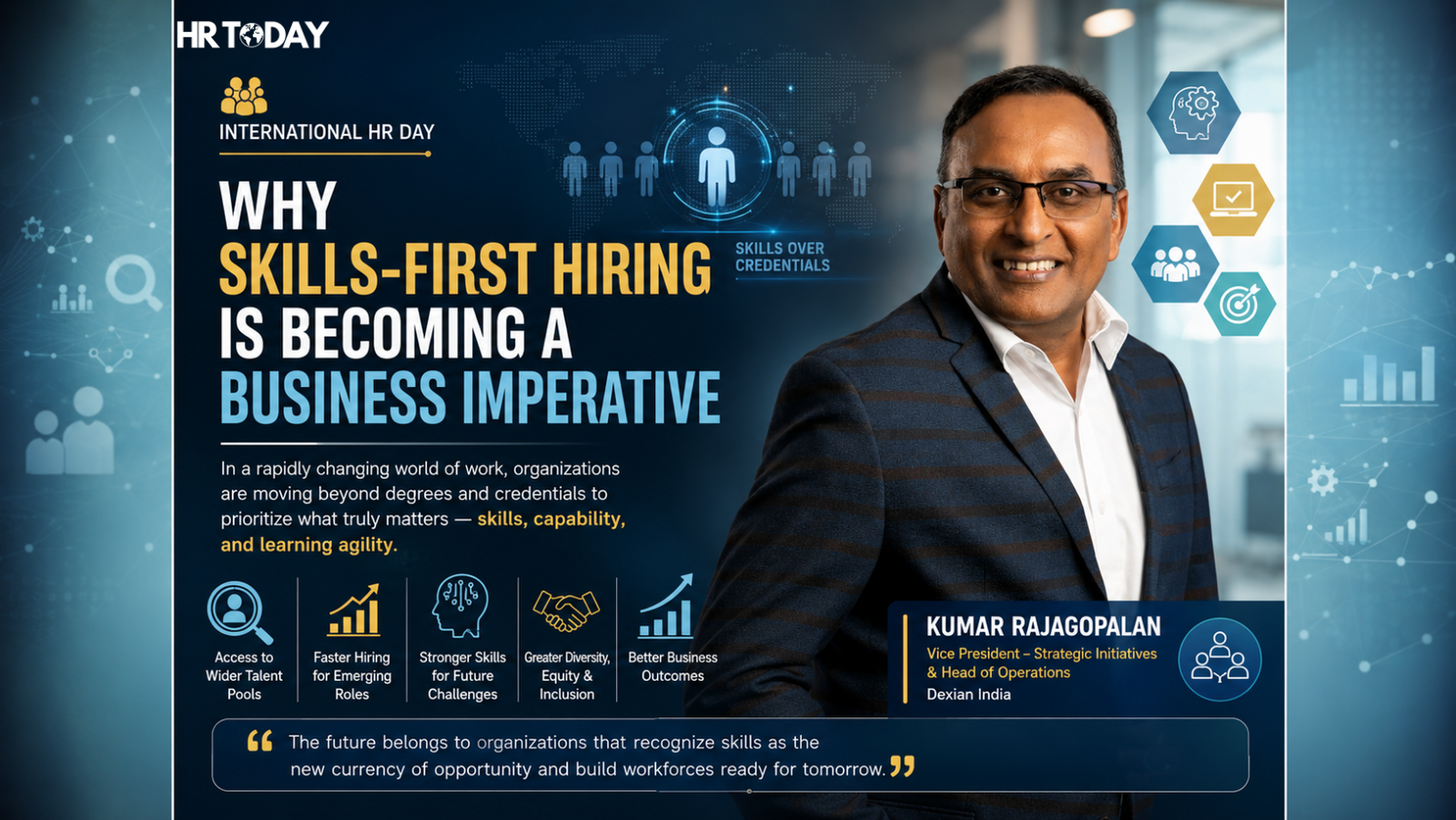
In the world of business, things are changing at a rapid pace and companies are re-evaluating how they think about one of the most fundamental aspects of growth: hiring. For many years, when it came time to hire a new employee, most businesses relied on degree’s, institutions of higher learning, years of experience and other traditional forms of credentials. Candidates who applied for jobs often had their resumes screened by hiring managers or recruitment agencies who assessed their qualifications and determined whether or not they were qualified to enter the talent pipeline. However, as many industries evolve with unprecedented speed due to technological advancements and globalization, these traditional hiring practices are evolving along with them. Companies are increasingly adopting a skills-first hiring approach…where employees are selected based on their actual capabilities rather than formal credentials. Skill-based hiring is now viewed as a necessity by organizations, not just a leading-edge HR practice.
An Evolution from Credentials to Capabilities
Hiring systems were based on the premise that degrees and designations equated to an individual’s ability to perform a job. In many cases the traditional hiring approach has eliminated talented individuals because they possess all the skills necessary for the position but do not possess the traditional credentials. Today’s employers recognize that able-bodied individuals with strong practical skills will be much more likely to perform at a high level in their job than individuals with only formal academic background will be able to perform. A person can develop their coding skills, communication skills, analytical/data driven competencies, problem-solving abilities, team-building capabilities and project completion skills through several different avenues (e.g. training, boot camps, working as an independent contractor, completing an internship and/or self-directed learning). Employers are now asked a different question than they would have been even just a short time ago: instead of ‘Where did you receive your education?’ The question now being asked is ‘What can you do?’. By implementing this new hiring method, employers can now assess potential employees based on their capabilities instead of their background.
The Growing Skills Gap Is Reshaping Recruitment
Skills shortages are changing the way companies hire employees through the development of the ‘skills-first’ hiring method. The rapid expansion of skills gaps throughout multiple industries has become one of the most important factors for both business and job seekers. Many companies worldwide have found it increasingly difficult to find qualified candidates to fill role-specific positions across many diverse industries, including technology, artificial intelligence, cyber security, healthcare, digital marketing, and advanced manufacturing. In fact, job positions corresponding to today’s marketplace did not even exist ten years ago and many of the job positions that existed may no longer exist in the next ten years due to the rapid pace of job evolution. It often takes universities and formal educational systems years to redesign their curricula in response to market changes. As a result of these evolving job positions and the long, gradual approach to qualifying potential candidates through educational requirements, businesses can no longer rely on traditional talent sources for all their hiring needs. The concept of ‘skills-first’ hiring now enables businesses to hire from a much larger candidate pool through the utilization of the ‘skills-first’ hiring practice of selecting a candidate based on the candidate possessing the skills required to perform the job rather than the completion of a traditional four-year degree or other educational program. In this manner, both businesses and applicants benefit from access to increased job placement opportunities while also alleviating a significant portion of the current workforce shortage.
Speed and Agility Have Become Competitive Advantages
The need for speed and agility has become a competitive advantage for modern business. The current business climate is characterized by continual change. Organizations must be able to respond rapidly to disruptive technologies, consumer behaviour changes, market opportunities, etc. At the same time when hiring candidates based upon their prior experiences, companies tend to slow their pace of adapting. Skills-based recruitment has created a mechanism for businesses to determine individuals with the ability to learn, grow, and contribute immediately. For example, a highly skilled individual who has expertise in an artificial intelligence (AI) tool or program, or has experience in a digital interactive workplace, can add value to the business quickly before ever having held a traditional formal degree that would qualify them for this piece of work. As a result of this type of recruiting practice, businesses can gain a competitive advantage by hiring individuals prepared to meet their pending future workforce needs.
Technology Is Streamlining the Process of Evaluating Competencies
With the rise of AI-driven hiring tools and digital recruitment platforms, evaluating competencies based on skills-first approaches has never been easier for employers. Employers now have numerous methods to evaluate candidates through different types of assessments, such as online testing, work samples, portfolio reviews, case studies, and evaluating qualifications based on a specific skill set, rather than just evaluating an applicant’s resume. These different assessment methods provide greater insight into a candidate’s actual capabilities than relying solely on resumes and allow recruiters to make more informed hiring decisions by providing measurable data regarding the candidate’s performance.
Business Results are Improved by Skill-Based Hiring Practices
Hiring based on competencies rather than experience offers not only greater access to talent, but also provides a measurable amount of business value. Employees who were hired based on their demonstrated ability to perform various job functions as opposed to the standard qualifications they possess will typically transition into the workforce more easily, as they possess the necessary skills required to successfully perform the work they are expected to complete. As such, fast-tracking new hires through the onboarding process has been associated with increased productivity, increased employee retention, and increased workforce efficiency. By hiring employees based on what they can actually produce, in addition to or instead of their qualifications, organizations generally develop a more diverse and efficient workforce, resulting in the organization being more capable of achieving its objectives.
Continued Learning Is Imperative to Prepare Workers for Future Work Opportunities
The root of the increased need for skills-first hiring can be attributed to the constantly shifting nature of work itself. Globalization, advances in technology, and other external factors have transformed and continue to rapidly change industries, and the skills that are valuable today may very well become obsolete in a matter of years (if not sooner). Therefore, hiring based on existing qualifications is no longer a viable solution for organisations; instead, they require employees who are willing and able to learn and who exhibit curiosity, adaptability, learning agility, and problem-solving skills. This has resulted in a shift from hiring for static jobs to hiring talent based on long-term potential. In this way, hiring based on skills aligns with the shifting view of learning as an inherent part of human existence, rather than as a single event that is achieved at a moment in time.
Final Thoughts
There is a greater trend within organisations to see talent differently than in years past. Years of degree and experience are recognised as valuable but no longer are considered to be the only indicators of whether someone will succeed within a rapidly evolving economy. As organisations look to build a more responsive workforce and compete for jobs within a chronically tight labour market, there is no longer a question as to whether organisations should use skills-based hiring, but rather how quickly they will transition to using them. In a world where ability is more important than the background of a person, the traditional view of what an employee can do with their skill set will no longer be sufficient. Skills are seen as the new currency of opportunity.
Read Also : When Technology, Business, and HR Converge: Why Embedding Ethical AI at Scale Matters
Burnout Isn’t a Time Management Problem—It’s a Leadership Problem
Learning, Education and Pedagogy in the age of AI : Developing Human Capital for the coming Decades
Rethinking Talent in the Age of AI: Why Workforce Agility Starts with the 4Bs
The Rise of the Chief Human Agency Officer: Why Every AI Organization Will Soon Need One