

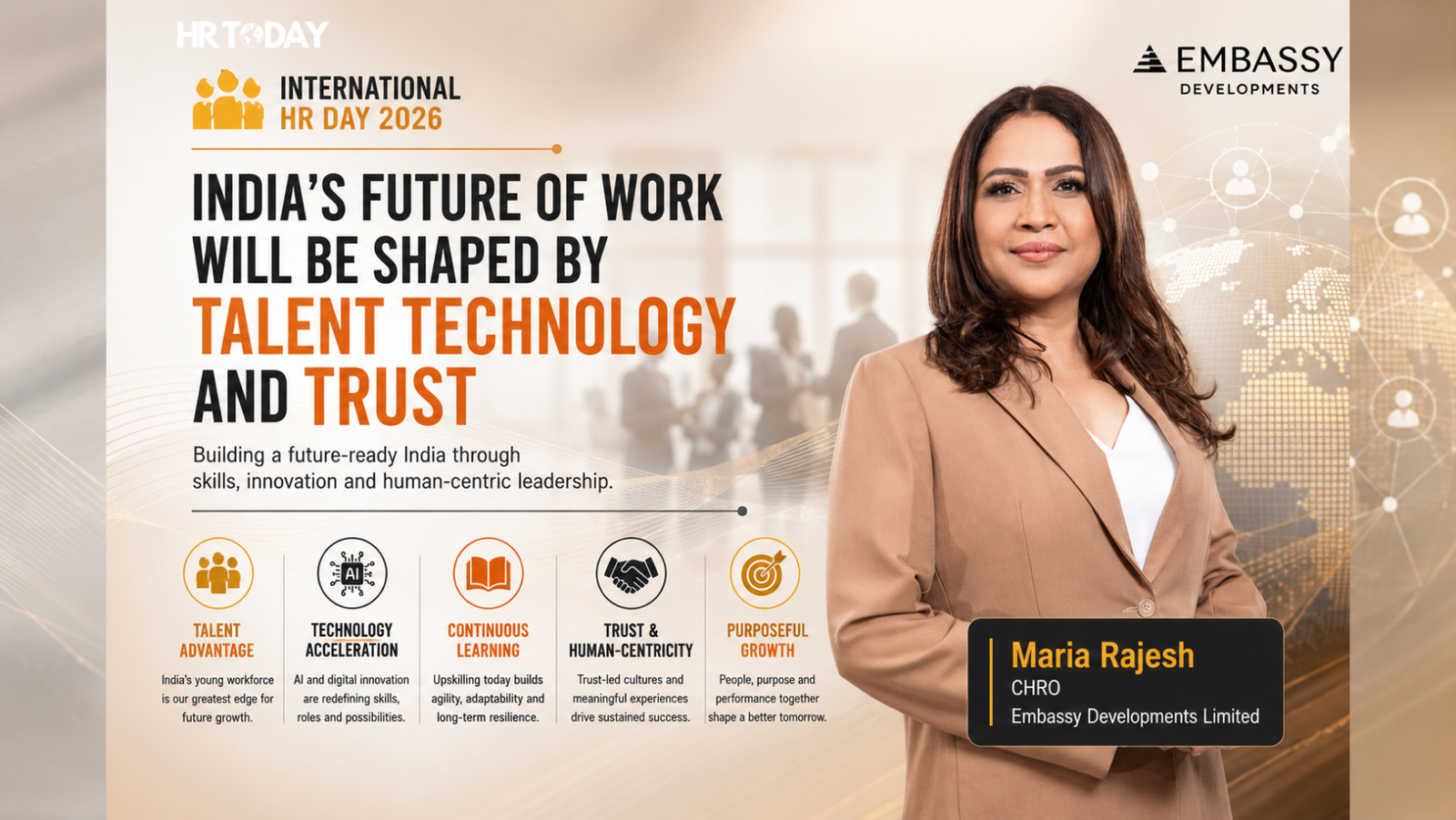
India today stands at a defining moment in its workforce evolution. A convergence of digital acceleration, rapid artificial intelligence adoption, and one of the youngest talent pools in the world is reshaping how work is created, delivered, and experienced. India has one of the youngest workforces globally, with over 65% of its population under the age of 35. This large and increasingly digital-first talent base can be trained and adapted for AI-driven industries, creating a strong foundation for innovation and new-age employment. This is not a gradual shift, but a deeper structural transformation that presents India with a once in a generation opportunity to emerge not just as a global talent hub, but as a leader in shaping the future of work itself.
Over the last decade, India has demonstrated its strength in scale. Today, the conversation is moving beyond scale to readiness. Preparation will define how effectively India navigates an AI-led future, stressing upon the importance of sustained investments in skilling and reskilling. This urgency is echoed in industry discussions at the Pearson Skills Summit 2026, where it was noted that over 60% of India’s workforce will require reskilling by 2030, even as less than half of graduates are considered directly employable in today’s evolving job market. At the same time, sectors across manufacturing, services, and infrastructure are seeing a growing demand for specialised skills that combine technical expertise with adaptability and critical thinking.
This shift signals an important inflection point. The future of work in India will not be defined by how many people enter the workforce, but by how effectively they are prepared to contribute to a rapidly evolving, technology-led economic landscape.
Evolving workforce landscape
The nature of work is undergoing a fundamental transformation. Traditional role definitions are giving way to more fluid, multidisciplinary responsibilities that require individuals to move across functions, tools, and technologies with ease. A marketing professional today is expected to interpret data. An operations leader increasingly works alongside automation systems. Even roles within infrastructure and real estate are being redefined by digital planning tools, sustainability mandates, and intelligent building systems.
The shift extends beyond changing job roles to redefining how work is experienced and valued. Employees today are placing greater emphasis on purpose, flexibility, and continuous growth, seeking roles that offer not just progression, but also a sense of meaning and belonging. Careers are no longer linear routes, but evolving journeys shaped by learning, exposure, and adaptability over time.
For organisations, this requires a fundamental rethink of how talent is structured and enabled. The focus is shifting from managing roles to building capabilities. Success will increasingly depend on how effectively organisations can create agile environments where individuals are empowered to learn, adapt, and contribute across multiple dimensions.
Unlocking India’s talent potential
India’s much discussed talent gap is often framed as a constraint. In reality, it represents one of the country’s most significant opportunities. With a workforce that continues to expand and diversify, India has the potential to build a powerful competitive advantage if talent development is aligned with emerging industry needs.
The challenge lies in bridging the disconnect between education and employability. While millions enter the workforce each year, a significant proportion lack the practical, job-ready skills required in a technology-driven economy. This creates a paradox where opportunity and shortage continue to exist side by side.
Addressing this requires a systemic shift. Organisations are increasingly moving toward hiring for potential rather than pedigree, recognising that adaptability and learning agility are critical in a rapidly changing environment. Industry, academia, and policy institutions are collaborating more closely to redesign curriculum, expand vocational pathways, and integrate real-world learning into education systems.
When aligned effectively, India’s demographic advantage can become a catalyst for innovation and growth. The focus must therefore move beyond access to opportunity toward building a workforce equipped for the future economy.
Upskilling as a growth engine
Upskilling has gradually moved from the edge to the core of business strategy. In an environment where skills are evolving faster than roles, the ability to continuously learn has become a defining factor of both individual and organisational success.
Organisations that invest in learning are seeing tangible outcomes, particularly in retention and engagement. As roles continue to evolve, employees increasingly value opportunities that allow them to build new capabilities, grow within the organisation and feel supported through inclusive and meaningful employee experiences. This has led to the emergence of structured learning ecosystems within organisations, including internal academies, digital platforms, and clearly defined career pathways.
What is important is the shift toward collaborative skilling models. The scale of India’s workforce transformation cannot be addressed by any single stakeholder. From co-created curriculum to apprenticeship-based training and national skilling initiatives, this ecosystem approach is helping align talent supply with market demand.
Technology is accelerating this shift. Edtech platforms are enabling scalable, flexible, and personalised learning, allowing individuals to build skills in real time. At the same time, organisations are expanding their focus beyond technical capabilities to include leadership, communication, and problem-solving skills, recognising that these will be critical in navigating complexity.
Equally important is the role of trust and learning-led cultures in enabling long-term growth. Organisations that embed continuous learning into their culture and create environments where employees feel valued and included are increasingly emerging as stronger, more resilient workplaces.
Upskilling is no longer just about preparing for the next role. It is about building the capacity to evolve continuously. Organisations that embed this mindset into their culture are not just developing skills. They are building resilience.
Humanising AI in the workplace
Artificial intelligence is often viewed through the lens of automation. However, its true potential lies in augmentation. The future workplace will not be defined by machines replacing humans, but by how effectively the two work together.
AI brings speed and precision, while humans continue to bring creativity, empathy, and contextual understanding. Together, they can unlock new levels of productivity and innovation. As AI adoption accelerates, a growing share of work activities is being augmented by intelligent systems, fundamentally changing how tasks are executed and decisions are made.
For organisations, the real opportunity lies in thoughtfully designing systems. This requires moving beyond technology adoption to thoughtful integration. Workflows must be reimagined so that AI enhances human capability rather than displacing it.
At the same time, humanising AI is essential. As employees navigate this transition, concerns around job security, relevance, and trust must be addressed. Transparency in how AI is deployed, along with investments in reskilling and digital fluency, will play a critical role in building confidence. Responsible adoption frameworks that prioritise ethics, governance, and workforce transition planning will also be critical, ensuring AI is implemented in a way that is both sustainable and inclusive.
This shift is also redefining leadership in the workplace. In an AI-enabled and increasingly multi-generational workforce, leaders will need to balance technological progress with empathy, adaptability, and human connection, while creating environments that encourage collaboration and continuous learning.
Importantly, the rise of AI is reinforcing the value of distinctly human skills. Creativity, ethical judgment, collaboration, and emotional intelligence are becoming more, not less, important. The organisations that will succeed are those that recognise AI as an enabler of human potential, not a substitute for it.
Building future ready talent pipelines
As the pace of change accelerates, organisations are rethinking how they build and sustain talent. External hiring alone is no longer sufficient to meet the demand for specialised skills and leadership capabilities. This has led to a renewed focus on developing talent from within.
Future ready organisations are investing in structured career pathways that provide clarity and mobility. Employees are being encouraged to explore cross-functional roles, build diverse skill sets, and take ownership of their growth journeys. Leadership development is becoming more intentional, with early identification of high potential talent and targeted programs to nurture them.
Internal mobility is emerging as a critical lever. By enabling employees to move across roles and functions, organisations can better utilise existing capabilities while also driving engagement and retention. This approach allows for a more dynamic and responsive workforce, where skills are continuously redeployed based on evolving business needs.
The emphasis is shifting from short-term hiring to long-term capability building. Organisations that take a sustained and strategic approach to talent development will be better positioned to navigate uncertainty and drive consistent performance.
The way forward
India’s path to becoming a global leader in the future of work will depend on how effectively it aligns talent, technology, and infrastructure. Each of these elements is evolving rapidly, but their true potential lies in how they come together.
The opportunity ahead is significant. By investing in skills, embracing technology responsibly, and creating environments that enable people to thrive, India can build a workforce that is both competitive and inclusive. This will require a long-term perspective and a willingness to rethink traditional models of work, learning, and leadership.
The future of work will not be determined by technology alone, but by how organisations lead people through change. Organisations that place people at the centre of their strategies, while leveraging technology and infrastructure as enablers, will be best positioned to lead this transformation.
As India moves forward, the focus must remain on building robust and integrated ecosystems that support continuous growth. The decisions made today will not only shape the future of work in India, but also define the country’s role in helping shape the future of work globally.
Read Also : When Technology, Business, and HR Converge: Why Embedding Ethical AI at Scale Matters
Burnout Isn’t a Time Management Problem—It’s a Leadership Problem
Learning, Education and Pedagogy in the age of AI : Developing Human Capital for the coming Decades
Rethinking Talent in the Age of AI: Why Workforce Agility Starts with the 4Bs
The Rise of the Chief Human Agency Officer: Why Every AI Organization Will Soon Need One