

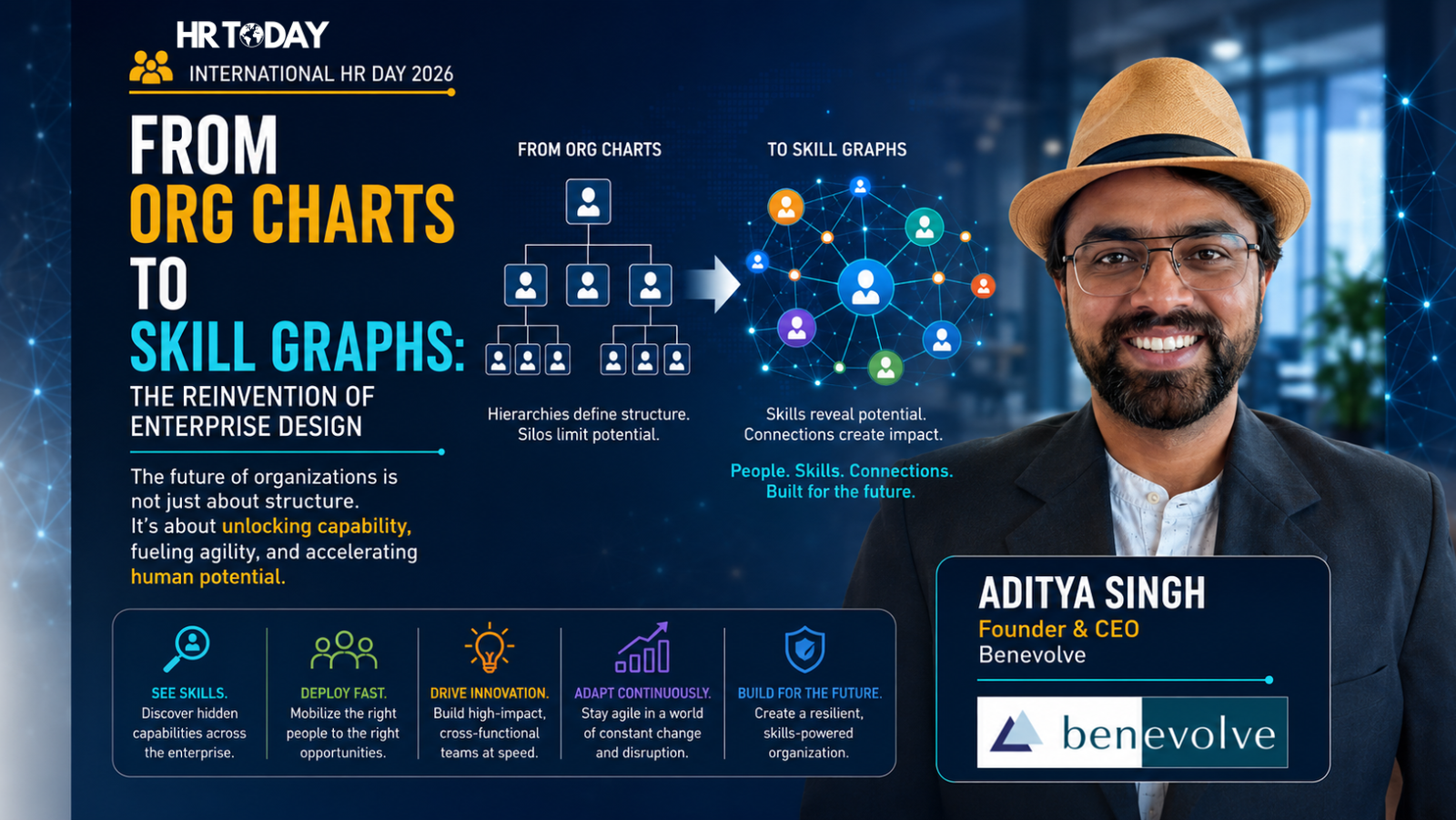
The org chart is one of the most enduring artefacts of industrial-era management thinking — a clean, hierarchical map of who reports to whom, what each person owns, and where accountability sits. For the better part of a century, it worked. Scale could be managed through layers. Complexity could be contained within silos. Stability was the operating assumption.
That assumption, however, is evolving rapidly. In a business environment defined by accelerating technological change, AI-enabled work, compressed product cycles, and the primacy of knowledge work, the traditional org chart is no longer sufficient on its own. It remains important for accountability, governance, and decision-making — but organisations will increasingly need a more dynamic and capability-led way to understand how work gets done.
The more consequential shift underway is not the disappearance of organisational structures, but their reinvention. Organisations will need to move toward more adaptive, skills-informed models that complement hierarchy with real-time capability intelligence. In that context, skill graphs — dynamic, data-driven representations of organisational capability — offer a meaningful way forward. For enterprise leaders, this is not a future-state consideration. It is increasingly becoming a present-day design imperative.
Why Organisational Structures Need Reinvention
Org charts were designed for a world of relative predictability, where roles were stable, processes were documented, and change moved slowly enough to be managed through planning cycles. That world no longer fully describes the operating environment of most enterprises. According to the World Economic Forum, millions of jobs will be displaced through automation, while millions more new roles will emerge that require fundamentally different skill combinations.
The challenge is not that organisational structures no longer matter — they do. The challenge is that traditional structures alone often provide only a static view of how organisations operate. They answer the question of who owns what, but are far less effective at answering what people can actually do, what hidden capabilities exist across teams, and how talent can be mobilised dynamically when priorities change.
As skills evolve faster than job descriptions, organisations increasingly risk becoming blind to capabilities that exist beyond formal titles. The silo effect is often a direct consequence of this architecture. When departmental boundaries become the dominant organising logic, collaboration frequently requires navigating structures rather than simply bringing together the best talent to solve a problem.
With AI augmenting coordination and operational work, we also expect organisations to revisit how many layers are truly required. Over time, organisational structures are likely to flatten meaningfully. The highest pressure will likely be felt in middle-management layers, particularly where activities such as reporting, coordination, and information flow can increasingly be augmented through technology. This does not imply the disappearance of managers — rather, their role will evolve significantly toward coaching, capability building, problem-solving, and enabling cross-functional execution.
How Skill Graphs Present a Dynamic Alternative
Skill graphs do not replace organisational structures; they enhance them. Rather than mapping only authority and reporting relationships, they create a dynamic layer of intelligence that maps organisational capability — what individuals know, what they can do, and how those capabilities connect across the organisation.
The unit of analysis begins to shift from the role alone toward the broader skill set, enabling organisations to identify talent more dynamically and deploy capability where it matters most. In practice, this means project staffing decisions no longer need to be constrained purely by departmental membership or job title.
A data scientist in finance with deep expertise in supply chain modelling, for example, could be identified and deployed on a logistics optimisation initiative in real time rather than months later through formal redeployment processes. IBM’s internal talent marketplace, for example, has enabled the redeployment of thousands of employees to higher-priority projects without external hiring, generating measurable gains in both speed and capability alignment.
This becomes the compounding advantage of skill-informed organisations: latent organisational capability becomes visible and deployable. Cross-functional collaboration becomes easier, hidden skills become easier to surface, and organisations gain greater agility in responding to changing business priorities.
Bringing More Innovation to Current Structures
The connection between skills visibility and innovation velocity is not incidental — it is structural. Organisations that can identify, assemble, and reconfigure cross-functional teams around emerging opportunities faster than competitors create meaningful advantages, particularly in industries where speed and adaptability matter.
Skill-based talent intelligence accelerates this by compressing the time between problem identification and team assembly. When a real-time capability map exists, leaders can assemble teams around new initiatives in days rather than quarters, drawing on verified skills across the organisation rather than defaulting only to reporting structures.
Importantly, this does not mean current structures disappear. Rather, teams increasingly become more fluid around priorities, while core organisational accountability remains intact. We expect organisations to reorganise teams more frequently based on changing customer needs, strategic initiatives, and business outcomes.
The second-order effect is a learning organisation that builds upon itself. When employees clearly understand which skills are valued, which are emerging as strategically important, and how skill development impacts their career trajectory, intrinsic motivation to upskill increases significantly. The organisation’s capability base expands not only through formal learning investments but through continuous self-directed development.
Improved Employee Experience
The employee value proposition of skills-informed organisations is structurally different from that of traditional hierarchy-bound environments. In conventional structures, career progression is often largely vertical and constrained by role availability. Advancement frequently depends on a layer above opening up.
Skills-based architectures create a more multidirectional model. Career growth increasingly includes lateral moves, project-based experiences, stretch assignments, and cross-functional exposure. These become meaningful pathways for growth rather than secondary alternatives when promotions are unavailable.
Importantly, this model also surfaces hidden capability that traditional systems often overlook. Skills developed outside formal job scope — through side projects, prior careers, or self-directed learning — become more visible and actionable inside organisations. This can also help reduce biases tied to title, proximity, or traditional career pathways by focusing more directly on capability and contribution.
The Role of Technology
The feasibility of skills-informed organisational models at enterprise scale is increasingly enabled by advances in AI and talent intelligence platforms. Leaders have long understood the value of understanding workforce capability more deeply. Historically, however, maintaining a real-time, multidimensional skills model across thousands of employees was operationally impractical.
Platforms such as Eightfold, Gloat, and Workday’s Skills Cloud have meaningfully advanced the industry’s ability to infer and surface skills by analysing project histories, performance data, collaboration patterns, and self-declared expertise. These systems move organisations beyond static job descriptions toward living capability maps.
But the next frontier is not skills visibility alone, it is skills orchestration.
In building Benevolve, we have seen repeatedly that competitive advantage does not come merely from identifying skills. It comes from architecting how those skills are mobilised against strategy. It comes from connecting capability intelligence directly to strategy execution. That means translating business priorities into required capabilities, identifying real-time skill gaps, and dynamically aligning talent to evolving enterprise goals.
When skill intelligence becomes embedded into organisational design, workforce planning, performance architecture, and rewards systems, enterprises begin to behave differently. Talent becomes more fluid. Teams become more dynamic. Structures become more adaptive. Strategy becomes more executable because capability can move at the pace of change.
For enterprise leaders, the strategic question is no longer whether this transition will happen — it is already underway. The question is whether organisations proactively redesign their structures to thrive in an AI-enabled, skills-driven environment or respond reactively once capability gaps begin to impact business performance. The cost of reacting late, as with most structural shifts, is often significantly higher than adapting deliberately.
Read Also : When Technology, Business, and HR Converge: Why Embedding Ethical AI at Scale Matters
Burnout Isn’t a Time Management Problem—It’s a Leadership Problem
Learning, Education and Pedagogy in the age of AI : Developing Human Capital for the coming Decades
Rethinking Talent in the Age of AI: Why Workforce Agility Starts with the 4Bs
The Rise of the Chief Human Agency Officer: Why Every AI Organization Will Soon Need One