

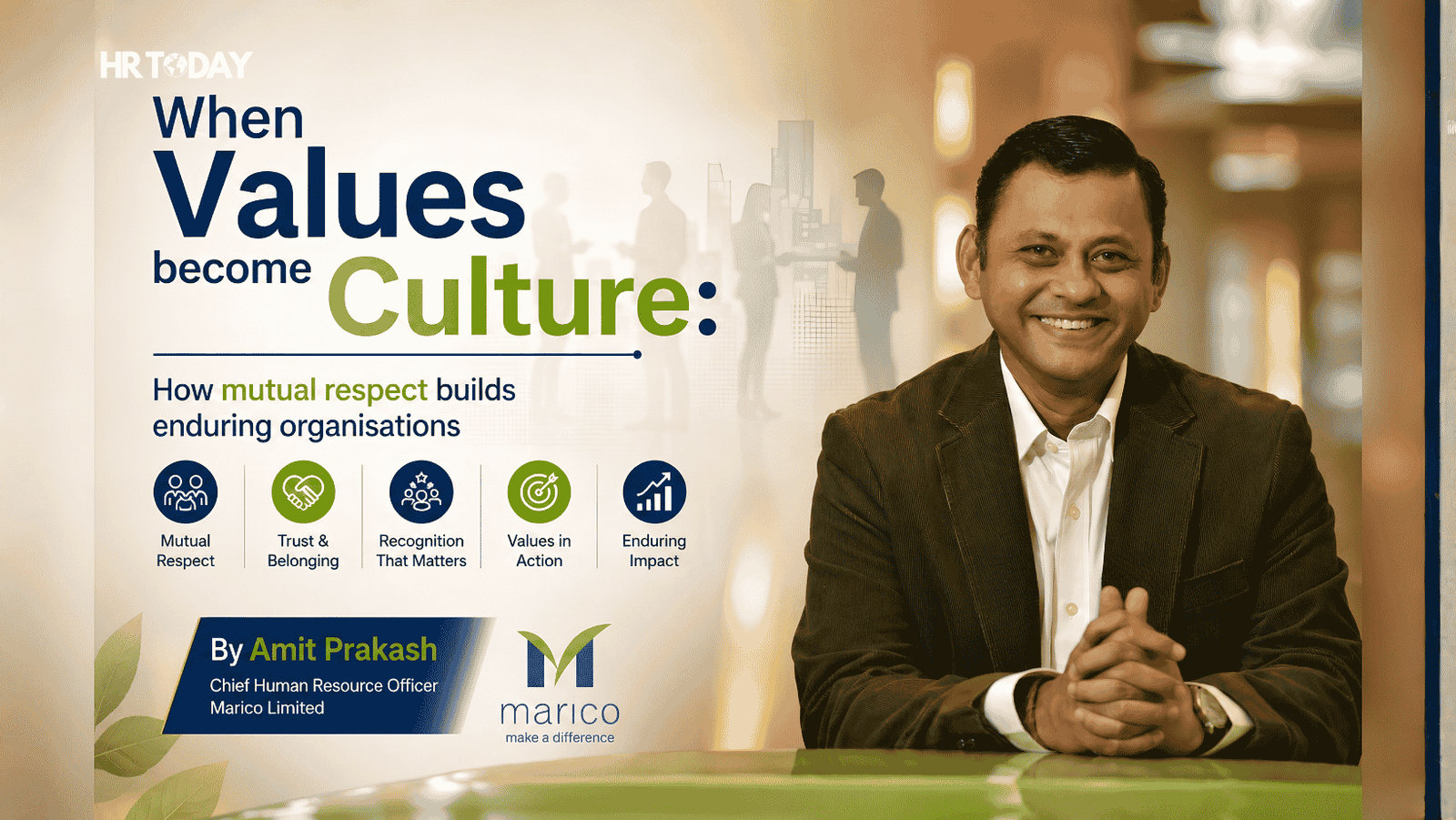
In most households, there are few written rules, yet expectations are clearly understood. People instinctively know when to listen, when to step forward, and how to engage in ways that preserve balance. Respect is rarely articulated, but it is consistently visible in behaviour. Trust, too, is not instructed; it is built quietly over time through repeated actions and shared experience.
Organisations are no different.
While values may be formally defined and widely communicated, their true presence is revealed in everyday behaviour particularly in moments that test judgements and alignments. Many organisations articulate their values with clarity and intent, embedding them into frameworks and reinforcing them through communication. Yet articulation alone does not create distinction. Values only matter when they are lived.
Values are not situational; they do not shift between personal and professional contexts based on convenience. They are shaped by individual belief systems and carried into the workplace through daily choices – choices that influence how people think, act, and respond. Culture becomes the space where these values are either strengthened through consistency or diminished through neglect. It is through everyday decisions and interactions that values gain meaning or lose credibility.
Values as the Foundation of Culture
Values establish direction, but culture determines how that direction is experienced across the organisation. When values are embedded in how teams collaborate, how leaders respond, and how decisions are made, they anchor the organisation in a meaningful and enduring way.
Respect moves beyond intent when differing perspectives are genuinely acknowledged. Trust is built not through declaration, but through consistent and fair actions that reinforce reliability over time. Appreciation, similarly, evolves from an occasional act into a natural part of how contributions are recognised and reinforced.
Culture does not take shape through grand gestures. It evolves through repetition- shaped by small but significant moments that collectively define how the organisation operates. When values are coupled with consistency, they transition from abstract principles into lived experience.
Enabling Values in an Organisation
Values ultimately find expression through the people who live them. While organisations create the frameworks within which values are articulated, it is leadership that determines how they are interpreted, prioritised, and applied in practice.
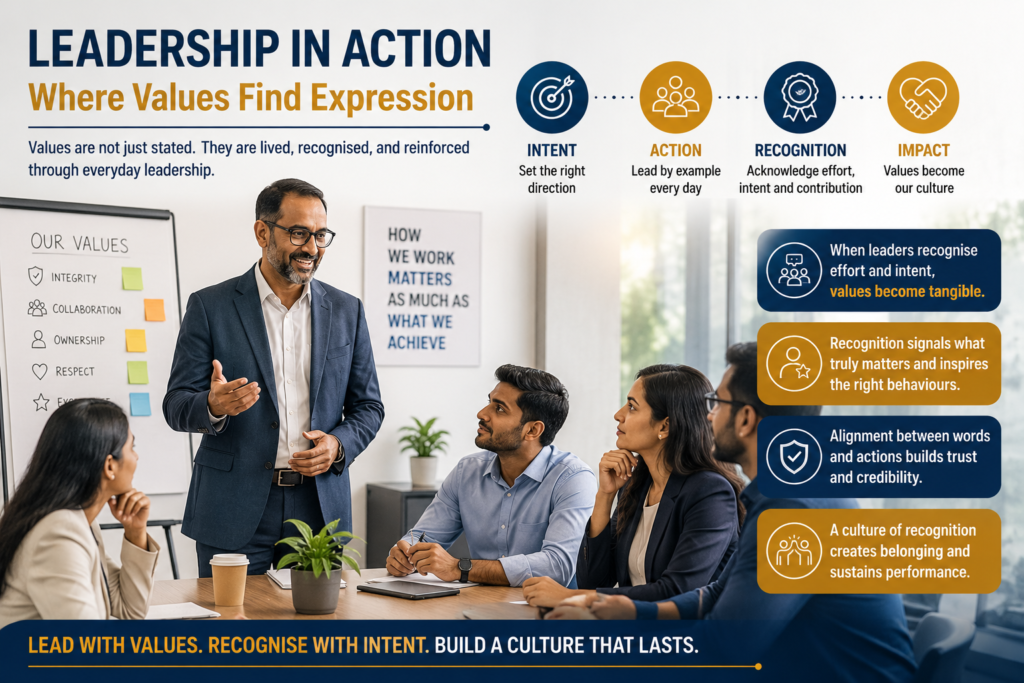
Leaders play a defining role in translating intent into action. When effort, intent, and contribution are acknowledged thoughtfully and consistently, values become tangible. Such recognition signals what truly matters, providing clarity not only on expected outcomes, but also on the behaviours that lead to those outcomes.
Consider a moment familiar to many teams: a project misses its intended outcome, yet the team has collaborated openly, challenged assumptions respectfully, and acted with clear ownership. When a leader chooses to recognise the quality of thinking and effort rather than focusing solely on the miss, it reinforces that values are not subordinate to results. In doing so, the leader signals that how work is done matters as much as what is achieved.
This alignment between what is stated and what is practised builds trust. It fosters a sense of belonging, where contributions are recognised with intent rather than routine. While policies may outline expectations, it is reinforcement through everyday actions that shapes culture in a lasting way. Recognition, in this context, becomes a quiet yet powerful force, one that embeds values into the organisation’s fabric.
Why Values Matter in Building Enduring Organisations
Organisations that endure are rarely defined by strategy alone. Strategies evolve in response to changing contexts. What remains constant is a shared value system that guides decisions, particularly in moments of ambiguity, constraint, and trade‑off.
When individuals operate with an owner’s mindset, accountability extends beyond defined roles to the outcomes they influence. Decisions become more deliberate, and execution more purposeful. A culture that places the end‑consumer at its centre encourages teams to think beyond immediate deliverables, aligning effort with long‑term relevance and impact.
Environments grounded in openness and trust allow ideas to move more freely than hierarchy alone would permit. They create space for individuals to contribute, challenge, and collaborate without hesitation.
Over time, values‑driven behaviour strengthens meritocracy ensuring that contributions are recognised based on impact rather than position while encouraging collaboration across boundaries and aligning growth with responsibility.
Values as the Foundation of Strong Organisational Relationships
In complex and continuously evolving organisations, consistency becomes a stabilising force. When values are lived each day, they build trust across teams and hierarchies by shaping how people listen, respond, and support one another, especially under pressure.
A culture grounded in mutual respect encourages openness and accountability, while sustaining the empathy required for strong relationships. People experience deeper connection when their contributions are recognised through a shared value lens enabling them to see not only the outcomes of their work, but also its alignment with what the organisation stands for.
Like the quiet order that sustains a household, values reveal their true strength not through articulation, but through consistent practice over time. When values guide how people think, act, and collaborate each day, culture becomes a defining advantage enabling sustained growth, meaningful impact, and enduring success.
A Call to Action for Leaders
For leaders, the challenge is not to create new values, but to ask a simpler and more demanding question each day: What behaviours am I reinforcing – consciously or otherwise? Every response, recognition, and decision sends a signal. Over time, those signals shape what people believe truly matters.
Building culture is therefore less about bold statements and more about quiet consistency. It requires leaders to notice moments that test values and to act with intent when they arise. When leaders choose alignment over convenience especially under pressure, they turn values into culture.
Enduring organisations are built when leaders recognise that culture is not an outcome to be managed, but a responsibility to be lived. The invitation is clear: lead in a way that allows values to show up every day, in small moments, through consistent action. Over time, that is what creates trust, resilience, and organisations that truly endure.
Read Also : How HR Leaders Are Redefining Talent Development for the Future of Work
Selective Increments, Strategic Hiring: How AI Skills Are Reshaping India Inc’s Appraisal Cycle
From Org Charts to Skill Graphs: The Reinvention of Enterprise Design
Rethinking Talent in the Age of AI: Why Workforce Agility Starts with the 4Bs
The HR Leader’s Real AI Problem Is Not Adoption. It Is Architecture.