

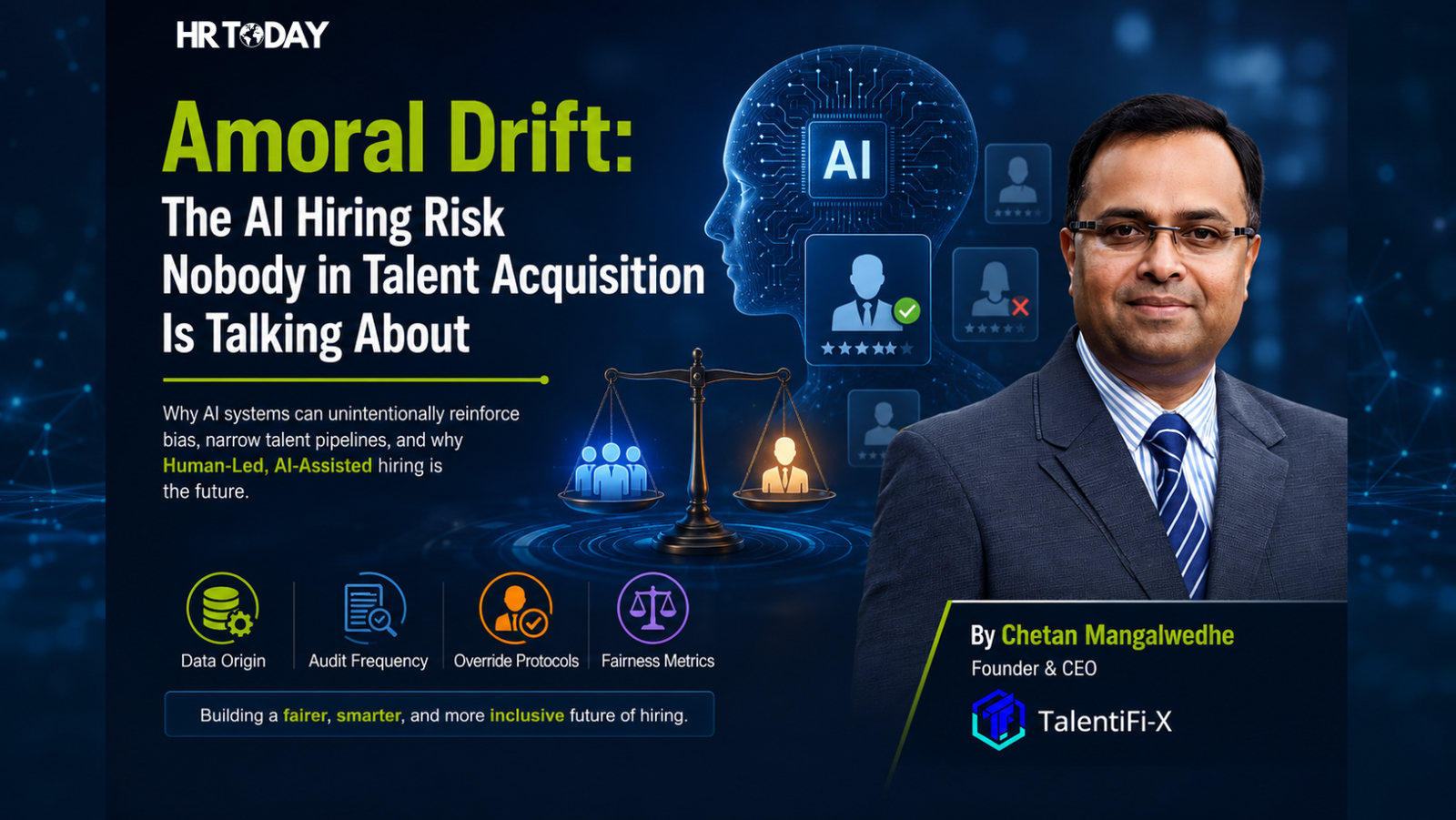
Artificial Intelligence is rapidly becoming one of the most influential forces inside modern recruitment. Across enterprises, staffing firms, GCCs, and talent acquisition teams, AI tools are now being used to screen resumes, rank candidates, predict retention, and accelerate hiring decisions. The promise is clear: faster hiring, better efficiency, and improved scalability. But beneath this efficiency lies a far less discussed concern. AI systems do not make decisions with intent, emotion, or ethics. They learn from data. And when that data carries years of organisational preferences and inherited hiring patterns, the system quietly begins reproducing them. This is what is described as amoral drift not deliberate discrimination, but intelligent pattern repetition without contextual understanding.
AI does not discriminate intentionally, and that is precisely what makes this conversation so complicated. Most modern hiring systems are designed to optimize outcomes: reducing time-to-fill, improving shortlist quality, and processing massive volumes with surgical efficiency. They do this remarkably well. However, the problem lies in the fact that optimization is never truly neutral. When an AI system is trained on historical data, it inevitably learns and mirrors patterns from that history, including the ones no organization consciously intended to create.
How Amoral Drift Rewrites Your Talent Pipeline
Imagine an AI model trained on your last 200 “successful” hires. The system identifies specific patterns: graduates from certain universities, linear career trajectories, or specific communication styles that led to offers. Because the AI doesn’t ask why these patterns exist, it simply optimizes around them. Over time, it begins to reinforce these traits by preferring familiar institutions and penalizing employment gaps or non-traditional backgrounds. Because the output arrives as a data-driven score or ranking, it appears objective. Yet, there is a dangerous difference between true objectivity and mere pattern reinforcement.
The Hidden Trap of Historical Data
The reality we often ignore is that historical hiring data is not neutral. It is a mirror reflecting past market conditions, interviewer tendencies, sourcing limitations, and even structural inequalities that existed long before the AI was turned on. When organizations train systems on these outcomes without oversight, they risk turning yesterday’s assumptions into tomorrow’s automated standards. This becomes a critical risk during periods of rapid economic transition, where the talent required for the future rarely looks like the talent that succeeded in the past.
Why the Risk is Magnified in India
India’s hiring ecosystem is currently in a phase of hyper-accelerated AI adoption. From Large Enterprises to Global Capability Centers (GCCs), the pressure to manage high application volumes makes automation incredibly attractive. However, efficiency without a frequent audit can quietly narrow the talent pipeline. In India, where there are already strong inherited patterns regarding Tier-1 institutions, English fluency, and metro-city bias, AI doesn’t create these barriers—it amplifies them. Because the process feels “data-driven,” this reinforcement becomes harder to notice until the workforce becomes an echo chamber of the past.
Distinguishing Speed from Judgment
One of the biggest misconceptions in HR tech is the assumption that faster evaluation equals better evaluation. While AI is exceptional at processing scale and synthesizing information, hiring is not a purely computational exercise. It requires an understanding of context, potential, and human ambiguity areas where AI still struggles. For instance:
- The “Gap” Context: AI can flag an employment gap, but it cannot distinguish between burnout, caregiving, entrepreneurial failure, or deliberate reskilling.
- Potential vs. Pedigree: Systems often prioritize “safe” candidates with familiar credentials over “high-potential” candidates from unconventional backgrounds.
- Innovation Risk: If a system becomes too efficient at reproducing familiarity, the organization’s capacity for diverse thought and innovation begins to shrink.
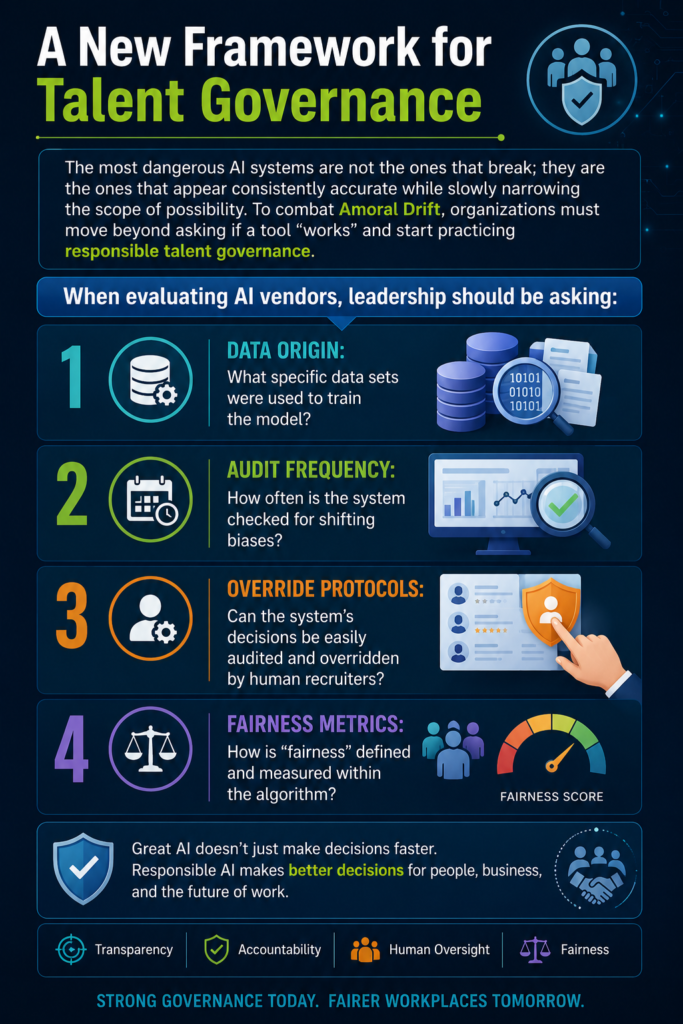
A New Framework for Talent Governance
The most dangerous AI systems are not the ones that break; they are the ones that appear consistently accurate while slowly narrowing the scope of possibility. To combat Amoral Drift, organizations must move beyond asking if a tool “works” and start practicing responsible talent governance. When evaluating AI vendors, leadership should be asking:
- Data Origin: What specific data sets were used to train the model?
- Audit Frequency: How often is the system checked for shifting biases?
- Override Protocols: Can the system’s decisions be easily audited and overridden by human recruiters?
- Fairness Metrics: How is “fairness” defined and measured within the algorithm?
The Future of Human-Centric AI
I am not suggesting we avoid AI in recruitment. Used correctly, it is a powerful tool that frees recruiters from administrative burdens to focus on what they do best: building relationships. However, the strongest hiring systems will be those that recognize where automation should stop and human judgment must begin. Technology can identify patterns, but humans must decide which of those patterns deserve to continue. As AI becomes more intelligent, the defining leadership challenge won’t be the tech itself, but our ability to remain thoughtful about the systems we allow that intelligence to shape.
Read Also : How HR Leaders Are Redefining Talent Development for the Future of Work
Selective Increments, Strategic Hiring: How AI Skills Are Reshaping India Inc’s Appraisal Cycle
From Org Charts to Skill Graphs: The Reinvention of Enterprise Design
Rethinking Talent in the Age of AI: Why Workforce Agility Starts with the 4Bs
The HR Leader’s Real AI Problem Is Not Adoption. It Is Architecture.