

Did you know that a lot of digital features, or infrastructure innovations that we take for granted today, like predictive speech, voice announcements in lifts, screen backgrounds, were originally designed to keep persons with disabilities in mind?
Did you also know that not all persons with disabilities are born with a disability. 90% of disabilities are acquired within the age range of 18 to 65 years, due to illness, accidents, and even crimes. Disabilities arising out of acid attacks are an outcome of crime. A lot of locomotor disabilities get acquired after unfortunate accidents. Multiple sclerosis gets diagnosed in the late 20s or later. Many hidden disabilities like dyslexia, dysgraphia, ADHD, Bipolar disorder ho undiagnosed for years for fear of stigma.
Any one of us can join the PwD community at any time, and that’s the hard truth. If we do not open our minds and hearts to an accessible world, we are closing doors for ourselves.
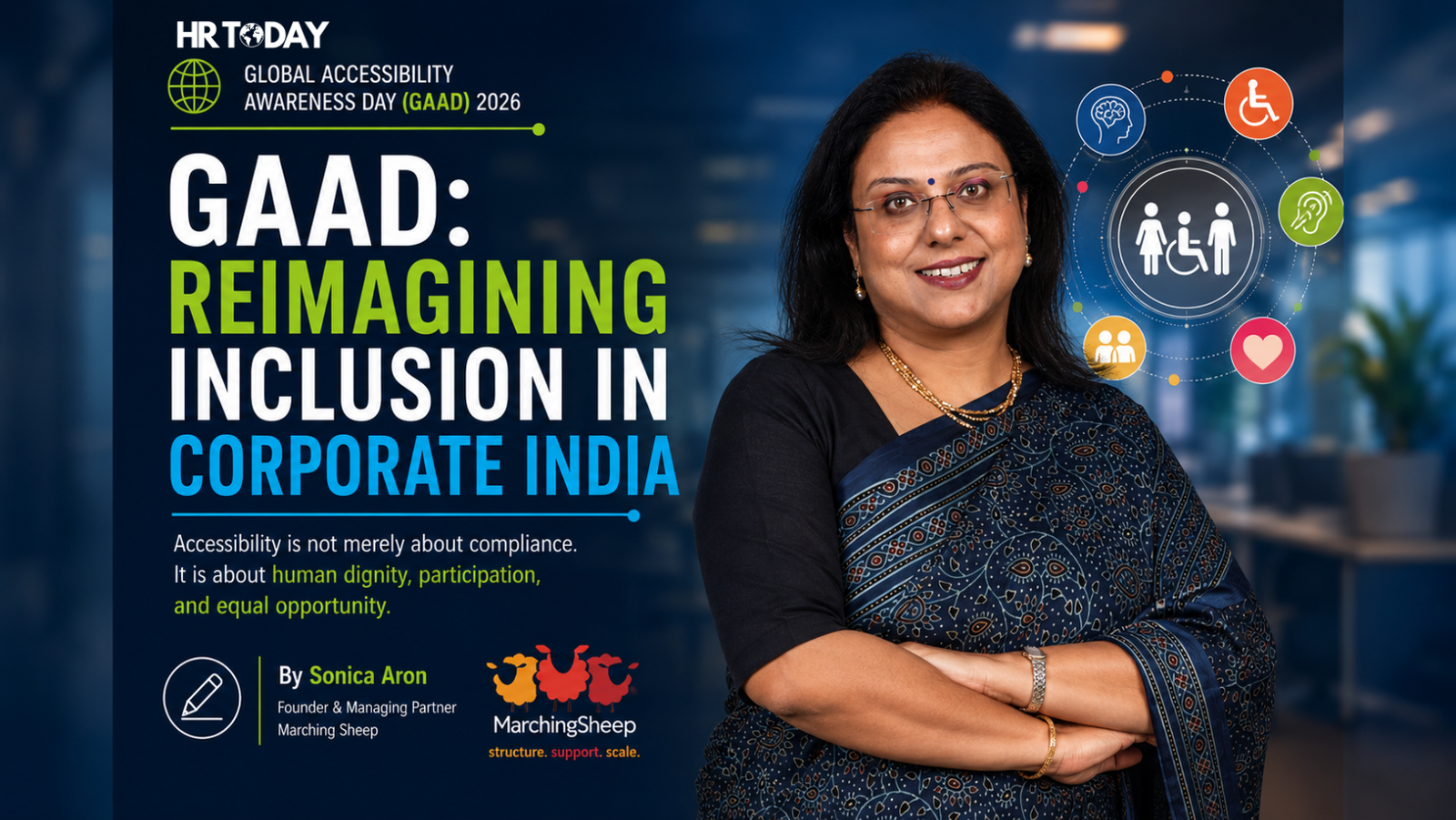
Global Accessibility Awareness Day (GAAD) reminds us of another truth: accessibility is not merely about technology, compliance, or sporadic initiatives. At its heart, accessibility is about human dignity, participation, and equal opportunity.
While discussions around workplace inclusion have certainly evolved in India over the last decade, it is also true that, when viewed through the lens of persons with disabilities, neurodivergent employees, and those navigating invisible barriers in the workplace environment, accessibility conversations tend to fall short of expectations.
Inclusion is still not a seamless process.
Inclusion Cannot be Built Around the “Ideal Employee”
The traditional model of the workplace was built around the archetype of the “ideal employee,” who could work long hours, travel frequently, communicate in standardised ways, adapt to inaccessible infrastructure, and conform to the expectations of the workplace.
However, today’s workforce is much more diverse in terms of experience, ability, identity, and working styles.
While the traditional understanding of accessibility includes wheelchair ramps, accessible washrooms, and other such facilities, it is also about how organizations communicate, conduct meetings, design their digital infrastructure, lead their teams, recruit and onboard employees, measure performance, and create psychologically safe environments where employees can ask for accommodations without fear.
Too often, employees hesitate to disclose disabilities out of fear of being labelled or discriminated against. Many organizations, too, limit their discussions on accessibility to persons with visible disabilities, while ignoring the needs of individuals with invisible disabilities, chronic illnesses, mental health issues, and temporary accessibility needs.
In a world where future readiness, innovation, and sustainability are critical, accessibility cannot be an afterthought or an optional add-on anymore.
Accessibility is a Business Imperative, not a Charity Conversation
Perhaps one of the biggest changes that Indian workplaces need to make regarding accessibility is moving beyond the charitable, or sympathetic, approach to accessibility.
Accessibility is not about ‘helping’ persons with disabilities. Instead, it is about ensuring that all employees can participate and contribute equally and have the opportunity to add to organizational success.
Across the world, companies are increasingly recognizing the benefits of accessible and inclusive workplaces in the form of innovation, employee engagement, talent retention, employer branding, customer experience, and even organizational resilience.
Accessibility, in other words, is about creating systems that enable more people to participate effectively.
Indian companies cannot aspire to become global talent hubs and innovation centers if they remain inaccessible to large chunks of talent.
The Gap Between Policy and Experience
In recent years, many organizations have developed ‘diversity and inclusion policies’, ‘accessibility statements’, and various other forms of policies aimed at making their workplaces more inclusive and enabling the hiring of more persons with disabilities.
While these initiatives are important, laudable, and a good starting point, the gap between policies and actual experience remains considerable.
Even while claiming to be inclusive, many organizations continue to maintain office infrastructures, recruitment processes, and working conditions that prevent persons with disabilities from accessing jobs or participating effectively in the workplace. Very, hiring persons with disability is an HR KPI with hiring managers continuing to be an invisible barrier. Having a diversity and Inclusion policy without having sensitized the managers is a tick mark.
The experience the employee has after joining is another consideration. Is it possible for an employee to ask for accommodation without fear of being judged? Can they participate equally in meetings? Are they providing equal opportunities for development and learning? Are they able to travel without risk? Can they advance in their careers or even join management positions?
These are some of the key questions that organizations need to consider seriously.
The Leadership Mindset is One of the Biggest Barriers
Through my experience of working with organizations on workplace culture, I have found that one of the biggest obstacles to achieving accessibility is the mindset.
Leaders often view accessibility through a compliance or legal framework. There is often an underlying belief that accessibility requires organizations to incur extra costs or makes the system unnecessarily complex.
More than anything else, what employees need from organizations is flexibility, empathy, and willingness to accommodate employee needs through thoughtful adjustments.
The role of managers is especially crucial in this regard. Too often, the experience of inclusion is determined not so much by organization policies as by the attitude of employees’ immediate managers.
Do managers create psychologically safe environments where all employees are able to participate equally? Do they understand the importance of accommodation? Is there a culture of respect and inclusion within the team?
If not, any number of accessibility initiatives will fail to bear fruit. Organizations must, therefore, ensure that their leaders are held accountable for accessibility.
Technology Can Enable Inclusion – But Only if Designed Thoughtfully
Today, technology has enabled organizations to design workplaces that can accommodate more people with disabilities. AI-assisted transcription tools, assistive devices, and flexible work arrangements are increasingly becoming common.
At the same time, however, technology can also create barriers if used incorrectly or inappropriately. Poorly designed digital systems can create unnecessary barriers and prevent employees from accessing basic workplace systems, including communication channels and learning modules.
Given the current trends of rapid technological adoption, it is imperative that organizations include accessibility as part of their technology design discussion.
For Indian organizations, which are increasingly embracing hybrid work models and digital workplaces, accessibility needs to be always considered. Employees should not have to struggle to access workplace tools, communication systems, or learning platforms.
In addition, organizations also need to recognize that accessibility is not just about external systems. They also need to ensure that internal employee systems, including HR portals, onboarding tools, learning modules, communication platforms, and workplace apps, are all designed to be accessible.
The Future of Work Needs to Be Human-Centered
Today, the future of work conversation in India tends to focus heavily on areas such as AI, productivity, innovation, automation, and digital transformation.
An important question to answer- who is behind the AI, the automation, the innovation? It’s a human being.
Therefore, the future of work needs to be human-centered. With every advancement that we adopt, are our employees becoming more stress free, efficient, productive? Are they able to make decisions better and faster?
Increasingly, employees are evaluating not only organizations’ salaries but also their workplace cultures, wellbeing practices, flexibility options, and inclusivity.
Younger generations, especially, are much more sensitive to social equity discussions and are increasingly expecting organizations to provide an inclusive workplace environment.
This shift is important because accessibility should not remain confined to corporate social responsibility initiatives or awareness events.
Instead, accessibility needs to become part of organizational culture.
To achieve this, organizations must:
- Design flexible and accessible workplace systems
- Create inclusive recruitment and onboarding processes
- Train managers on accessibility and inclusive leadership
- Include persons with disabilities in leadership discussions
- Build psychologically safe workplaces
- Ensure digital accessibility across all platforms
- Measure inclusion based on employee experience
Above all, organizations need to engage persons with disabilities directly in workplace discussions on accessibility.
Moving from Awareness to Action
GAAD is important because it helps raise awareness on topics that are often ignored.
Awareness, however, is not sufficient. Organizations in India now have an opportunity to move from awareness to meaningful action.
Ultimately, the organizations that will succeed in the future are those that are able to create cultures where employees feel respected, supported, and included.
This is because accessibility is not about trying to fit employees into rigid systems. It is about designing systems that enable more people to participate effectively.
That is true inclusion.
And, perhaps, that is the discussion that corporate India needs to have most urgently right now.
Read Also : When Technology, Business, and HR Converge: Why Embedding Ethical AI at Scale Matters
Burnout Isn’t a Time Management Problem—It’s a Leadership Problem
Learning, Education and Pedagogy in the age of AI : Developing Human Capital for the coming Decades
Rethinking Talent in the Age of AI: Why Workforce Agility Starts with the 4Bs
The Rise of the Chief Human Agency Officer: Why Every AI Organization Will Soon Need One